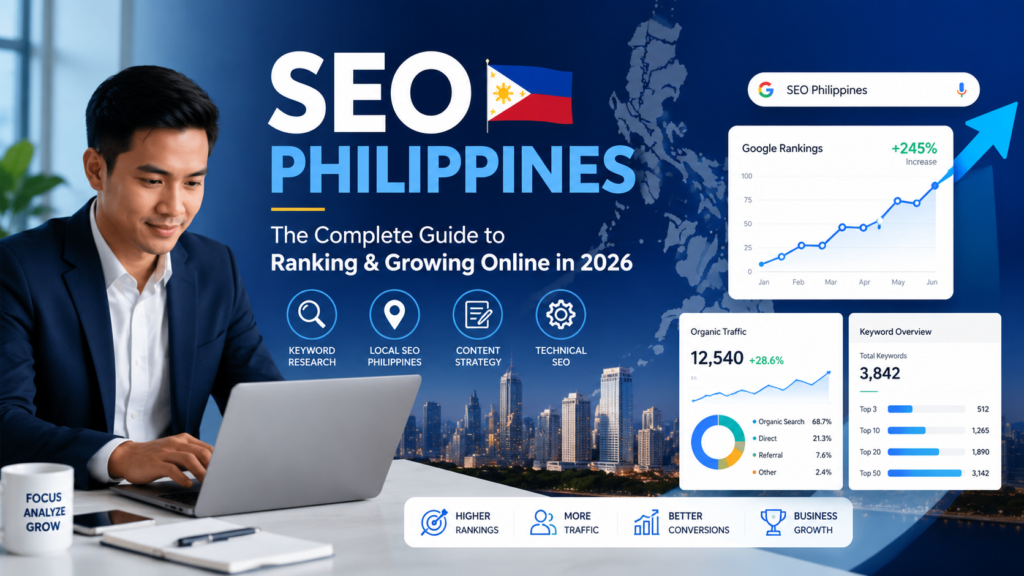
If you searched “SEO Philippines,” you’re one of two people: a business that needs to show up when Filipinos search Google, or a company abroad deciding whether to hire Philippine SEO talent. This guide is written for both — and built on what actually moves rankings in 2026, not 2018.
I’ve spent more than fifteen years doing SEO and web development from here in the Philippines — for local businesses, and for contractors and brands across the US and Australia. So I’ll skip the recycled “SEO is important” sermon and give you the version I’d give a paying client: what the Philippine market really looks like, which parts of SEO earn their keep here, what it costs, and how to tell a real specialist from someone selling you “guaranteed page-one rankings.”
Why SEO is non-negotiable in the Philippine market
The numbers make the case better than I can. By late 2025, the Philippines had roughly 98 million internet users — about 84% of the population — and around 95.8 million social media identities, according to DataReportal’s Digital 2026: Philippines report. Filipinos are also among the most digitally active people on earth, spending an average of around 54 hours a week consuming digital media — second only to Kenya.
Two more facts shape everything that follows:
- This is a mobile-first country, full stop. Smartphone ownership sits near 98.6% among internet users, and almost every search, map lookup, and “near me” query happens on a phone — often on mobile data, sometimes on a patchy connection.
- Google still owns search. Globally Google holds close to 90% of search; in the Philippines its lead is even more lopsided, and google.com is consistently the single most-visited site in the country, with over a billion monthly visits. If you’re being found through search here, you’re being found through Google.
For a business owner that means one thing: the audience is already online, already searching, and already on their phones. The only question is whether they find you or your competitor.
What “SEO Philippines” actually means
The phrase gets used two ways, and conflating them leads to bad decisions:
1. SEO for the Philippine market
Getting a business to rank for Filipino searchers — a Makati dental clinic, a Cebu resort, a nationwide e-commerce store, a service business in the provinces. This is about local relevance, Google Business Profile, and content that matches how Filipinos actually search (a mix of English and Taglish, heavy on “near me” and price-checking).
2. SEO talent from the Philippines
The country is one of the world’s largest hubs for outsourced digital work, and SEO is a big part of that. Agencies in the US, UK, and Australia hire Philippine specialists and teams because the talent is strong, English is native-level, and the cost is a fraction of hiring locally. I work this way myself — running technical SEO and strategy for overseas clients from Oriental Mindoro.
Both are legitimate searches. The rest of this guide covers the craft (which applies to both) and then splits out pricing and hiring for each.
The pillars of SEO that actually matter here
Local SEO and Google Business Profile
For any business with a physical location or service area, your Google Business Profile is more important than your website on day one. The “map pack” — those top three local results with the map — captures the lion’s share of clicks for “near me” and city-based searches. Claim and fully complete your profile, keep your name/address/phone identical everywhere, choose precise categories, post regularly, and treat reviews as a ranking factor, not vanity. In a country this relationship-driven, genuine reviews and fast replies move the needle hard.
Mobile-first technical SEO
Because nearly everyone is on a phone — frequently on mobile data — speed isn’t a “nice to have,” it’s the difference between a ranking and a bounce. The technical fundamentals I check first: Core Web Vitals on mobile, oversized images (the single most common drag I find on Philippine sites), render-blocking scripts, clean crawlable architecture, HTTPS with proper security headers, and a sensible internal-linking structure so important pages aren’t orphaned. Get the plumbing right before spending a peso on content.
On-page and content built for Filipino intent
Filipinos research before they buy, and they price-check relentlessly. Pages that win tend to answer the real question — how much, is it legit, where near me, how do I — in clear language. Write primarily in English (it dominates formal search), but don’t be afraid of natural Taglish in examples and FAQs where it matches how people actually type. Match each page to one intent, cover it thoroughly, and structure it so Google can lift answers cleanly.
The Facebook reality
You cannot do marketing in the Philippines and ignore Facebook — with roughly 95.8 million users, it remains the default discovery and trust layer for most Filipinos. SEO and social aren’t rivals here; they compound. People discover you on Facebook, then Google your name to verify you’re real. A strong organic search presence makes your social spend convert better, and an active page builds the brand searches that quietly lift your rankings.
AI search and answer-engine optimization (AEO)
This is the part most “SEO Philippines” articles haven’t caught up to. Filipinos are early adopters of AI: around 42% report using ChatGPT monthly — one of the highest rates in the world — and Google’s AI Overviews now sit above traditional results for many queries. That changes the job. Beyond ranking, you now want to be the source the AI cites: clear, well-structured, entity-rich content with schema markup, factual answers, and a credible author behind it. Sites that nail the fundamentals of clarity and trust are the ones getting pulled into AI answers.
Authority and links
Links still matter, but the safe, durable version is digital PR and genuine local relationships — local press, industry directories, partner mentions, real citations — not the cheap link packages that flood Filipino freelancer marketplaces. One toxic link blast can undo months of work. Earn fewer, better links.
How much does SEO cost in the Philippines? (2026)
The honest answer: it depends on scope, competition, and who’s doing the work. But here are the typical ranges I see in the market in 2026, so you walk into a sales call with a baseline rather than a blindfold.
| Engagement type | Typical monthly range | Best for |
|---|---|---|
| Freelance SEO specialist | ₱15,000 – ₱45,000 | SMEs, local businesses, single-site focus |
| Boutique agency / small team | ₱35,000 – ₱120,000 | Growing brands needing strategy + execution |
| Full-service agency | ₱100,000+ | Competitive niches, multi-location, e-commerce |
| One-off SEO audit | ₱10,000 – ₱60,000 | Diagnosing problems before committing |
| Project-based (e.g. site migration) | Quoted per scope | Specific technical projects |
If you’re a foreign agency hiring Philippine talent, you’ll typically pay a monthly retainer or hourly rate that’s a fraction of a Western hire for comparable skill — which is exactly why the model is so common. Whatever the figure, judge it against the value of the customers SEO brings in, not against the cheapest quote on the table.
How to choose an SEO specialist or agency in the Philippines
Use this as your vetting checklist:
- They ask about your business before pitching. Strategy comes from understanding your customers and margins — not from a template.
- They can show real work. Case studies, audits, before-and-after data. Vague claims are a red flag.
- They talk about technical SEO and Core Web Vitals, not just “we’ll post blogs and build links.”
- They understand local search and Google Business Profile if you serve a physical area.
- They report transparently — you should always know what was done and what it moved.
- They avoid black-hat shortcuts. Cheap link spam and AI-spun doorway pages are liabilities, not strategy.
- They communicate clearly. SEO is a months-long relationship; if you can’t get a straight answer now, you won’t later.
Why work with a Philippine-based SEO specialist
For Filipino businesses, a local specialist understands the market, the language, the buying behaviour, and the platforms your customers actually use. For overseas clients, Philippine SEO professionals offer native-level English, strong technical skill, and excellent value — which is why so much of the world’s SEO execution already runs through here. The point isn’t “cheap.” The point is the right work, done well, by someone who treats your rankings like their own reputation.
Common SEO mistakes I see in the Philippines
- Building the website first, thinking about SEO last. Architecture and keywords should shape the build, not get bolted on after.
- Ignoring Google Business Profile while obsessing over the website.
- Heavy, unoptimized images tanking mobile speed.
- Chasing cheap backlinks that invite penalties.
- Publishing thin, AI-spun content with no real expertise behind it — the fastest way to be invisible in 2026.
- Expecting overnight results. Meaningful SEO movement takes months; anyone promising instant wins is selling smoke.
Frequently asked questions
How long does SEO take to work in the Philippines?
Expect early movement in 3–6 months and stronger, compounding results from 6–12 months onward. Local SEO and Google Business Profile can show faster wins; competitive national keywords take longer.
Is SEO worth it for small businesses in the Philippines?
Yes — often more than for big brands. With 98 million people searching on mobile, a well-optimized Google Business Profile and a fast, focused website can deliver customers at a far lower cost than paid ads, and the results keep working after you stop paying.
SEO or Facebook ads — which should I prioritize?
They do different jobs and work best together. Facebook ads buy attention now; SEO earns trust and free traffic that compounds over time. In the Philippines, most people discover you on social and then Google you to confirm you’re legit — so you want both.
Can I do SEO myself?
You can absolutely handle the basics — claim your Google Business Profile, gather reviews, write clear pages, compress your images. Technical SEO, competitive content strategy, and clean link building are where a specialist usually pays for themselves.
Does AI search change SEO in the Philippines?
It raises the bar. With ChatGPT adoption among the highest in the world and AI Overviews appearing in Google results, the goal is now to be the clear, credible, well-structured source that AI tools cite — which rewards genuine expertise and clean technical foundations.
Want to know where your site actually stands?
I run technical SEO audits and growth strategy for businesses in the Philippines and abroad. Let’s find the gaps costing you rankings.