Introduction
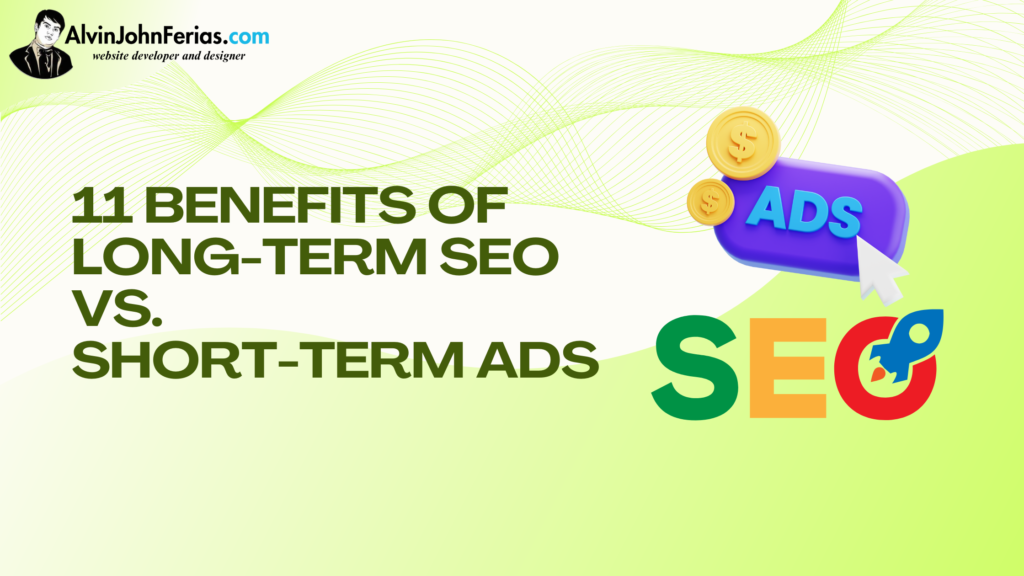
When it comes to growing a business online, most people end up choosing between two major strategies: long-term SEO (Search Engine Optimization) and short-term paid advertising. Both can drive traffic, both can generate leads, and both can help you grow—but they work in completely different ways. SEO is the slow-burning engine that builds momentum over time, while paid ads are more like stepping on the gas pedal: fast, direct, but only effective as long as you keep paying.
Think of SEO as planting a fruit tree. At first, it takes time, patience, and consistency. But once the tree matures, it keeps producing fruit every season—even if you step away for a bit. On the other hand, ads are more like buying fruit from the store. You get it instantly—but stop paying, and everything stops.
In this article, we’ll dive deep into the 11 biggest benefits of long-term SEO compared to short-term ads. Each benefit plays a major role in shaping the future of your brand online. And if you’ve ever wondered whether SEO is worth the effort, you’ll have your answer by the end.
1. Long-Term SEO Builds Sustainable Organic Traffic
One of the biggest advantages of SEO is sustainability. When your website ranks organically on Google, it keeps attracting visitors 24/7, even when you’re not actively promoting anything. This doesn’t happen with ads—traffic disappears the moment you stop paying. Long-term SEO compounds over time. A single well-optimized article can continue to bring in traffic for years. Paid ads? They’re like renting a hotel room—you get to stay only as long as you’re paying.
As your SEO improves, Google rewards your site by ranking more of your pages. Over time, this creates an interconnected ecosystem of organic traffic streams, each contributing to your brand’s growth. This compounding effect is powerful because the more traffic you get, the easier it becomes to rank for even more keywords.
Paid ads simply cannot match this snowball effect.
2. SEO Is More Cost-Effective Over Time
Short-term ads are expensive—and costs rise every year as competition increases. You might pay $1 per click today, $5 next year, and $10 the year after. SEO, on the other hand, becomes cheaper over time. The initial investment may seem larger, but once a page ranks, it continues generating free traffic with minimal upkeep.
SEO is like buying a house. Yes, the upfront cost might be higher, but you build equity, stability, and value over time. Paid ads are like renting—you pay forever and own nothing.
Businesses that invest in SEO early enjoy huge cost savings years later because they’re not dependent on paid ads to survive.
3. SEO Builds Strong Brand Authority and Trust
Consumers trust organic search results far more than paid ads. Why? Because appearing on page one of Google organically signals credibility, relevance, and authority. Google acts as a modern-day trust filter—if your brand shows up naturally, users assume it must be good.
SEO also supports brand trust by consistently putting your content in front of users across multiple touchpoints. The more users see you, the more credible you become. Ads don’t build long-term trust. They interrupt; SEO attracts.
4. Long-Term SEO Improves User Experience
Good SEO requires a good website. That means faster load times, better mobile optimization, improved navigation, and higher-quality content. This creates a smoother experience for users—and Google notices. Paid ads don’t require you to improve your website at all. You can have a slow, messy, confusing site and still run ads.
SEO forces you to improve everything:
-
Page speed
-
Mobile responsiveness
-
Content structure
-
Internal linking
-
Visual readability
And the better your site feels to users, the more likely they are to convert.
5. SEO Offers Higher ROI Compared to Ads
SEO consistently delivers a higher ROI than paid advertising because it produces compounding long-term returns. Ads give you instant visibility but no lasting value. Once the money is gone, the results disappear.
SEO flips that model entirely. Every piece of content becomes a long-term asset that works for you. Over time, ranking pages multiply your traffic, leads, and sales without requiring a continuous influx of cash. That’s why SEO delivers the highest ROI of any digital marketing strategy, year after year.
6. SEO Helps You Capture All Stages of the Buyer Journey
Paid ads are mostly used for bottom-of-funnel traffic—people ready to buy now. SEO allows you to target users at every stage:
-
Awareness: Informational searches
-
Consideration: Comparison searches
-
Decision: Transactional searches
With SEO, you nurture potential customers long before they’re ready to buy. When the moment comes, they already trust you. Ads rarely do this because each click costs money and advertisers avoid targeting early-stage keywords that don’t convert immediately.
7. SEO Delivers Compounding Returns
SEO is one of the few marketing channels with true compounding growth. One blog post can bring in 100 visitors a month. Another can bring 500. Add more content, and suddenly you’re at 10,000—then 50,000—and the growth becomes exponential.
This compounding effect comes from:
-
Increased keyword ranking visibility
-
Better domain authority
-
More backlinks
-
Stronger internal linking
-
Improved topic authority
Ads never compound. They are a flat line—pay to play, forever.
8. SEO Reduces Reliance on Constant Ad Spending
Depending solely on ads is financially dangerous. It puts your entire business at the mercy of fluctuating ad costs, increasing competition, and algorithm changes. One bad month and your leads could drop to zero.
SEO reduces this risk by creating a stable, predictable flow of organic traffic. Instead of relying on paid platforms like Google Ads or Facebook Ads, SEO gives you freedom and independence. You’re not renting your audience—you’re building it.
9. SEO Provides Long-Term Competitor Advantage
Ranking organically is difficult—which is exactly why it’s such a powerful competitive advantage. Once you secure top positions in search results, competitors can’t just outbid you like they can with paid ads. They have to outwork you, out-optimize you, and out-strategize you.
Ranking #1 is like owning prime real estate. Competitors may open stores nearby, but your location still brings the most traffic.
10. SEO Improves Conversion Rates Over Time
Organic users tend to be more informed, more trusting, and more intentional. They’re actively searching for solutions—not being interrupted by ads. This makes them far more likely to convert.
As your SEO content matures, conversion rates typically increase because:
-
Users spend more time with your content
-
They grow familiar with your brand
-
Your site becomes more optimized
-
You better understand what searchers want
This leads to better leads, more purchases, and higher lifetime customer value.
11. SEO Supports Multi-Channel Marketing Efforts
SEO amplifies everything:
-
Your email list grows from organic traffic
-
Social shares increase through high-value content
-
Remarketing campaigns become cheaper
-
Backlinks multiply naturally
Paid ads work alone. SEO feeds every channel around it, making your entire marketing ecosystem stronger and more effective.
Conclusion
Long-term SEO isn’t just a marketing strategy—it’s an investment in the future of your brand. While ads can deliver short-term bursts of traffic, they can never match the sustainability, trust, and long-term ROI that SEO provides. Businesses that commit to SEO early experience compounding growth, stable organic traffic, stronger branding, and long-term authority—all without being chained to a monthly ad bill.
If you want growth that lasts, SEO is the path.
FAQs
1. Is SEO better than paid ads?
Yes. SEO is better for long-term growth, while ads are better for quick, temporary results.
2. How long does SEO take to work?
Most websites begin seeing results in 3–6 months. Competitive industries may take longer.
3. Should I use SEO and ads together?
Absolutely. They work best as a hybrid strategy, but SEO should be the foundation.
4. Are ads worth it for new websites?
Ads are helpful for quick visibility, but they should not replace long-term SEO.
5. Can SEO work for small businesses?
Yes—SEO is one of the most affordable and effective strategies for small businesses.
Please don’t forget to leave a review.