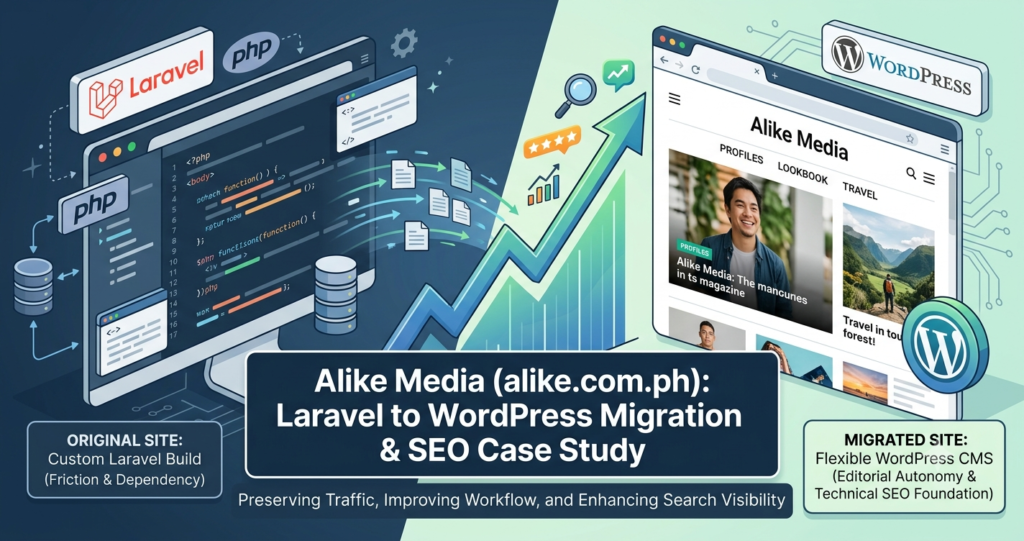
Alike Media (alike.com.ph) is a Philippine lifestyle and society digital magazine covering Profiles, Lookbook, Taste, Travel, Weddings, and Latest — the kind of editorial site that publishes new features almost daily and depends entirely on organic search and social discovery to reach readers. When the brand needed to move off its original custom-built platform, they brought me in to rebuild the entire site on WordPress and rework its SEO foundation from the ground up.
This case study walks through what that project actually involved: why a migration like this is risky for a content-heavy publisher, how I approached it, and what a Laravel to WordPress migration means for search visibility when it’s done properly.
About Alike Media
Alike Media positions itself as a platform “built on society and storytelling” — curating profiles of notable personalities alongside coverage of art, fashion, lifestyle, and culture in the Philippines. The site is organized into clear editorial verticals (Profiles, Lookbook, Taste, Travel, Weddings, Latest) and regularly features partnerships with hotels, brands, and events across the country.
For a publisher like this, the website isn’t a brochure — it’s the product. Every article is a potential entry point from Google, social shares, or direct search for a featured personality or brand. That made the stakes of any platform migration significantly higher than a typical business website rebuild.
The Challenge: Moving Off a Custom Laravel Build
Alike Media’s original site was built on Laravel, a PHP framework that gives developers full control over custom functionality but requires ongoing developer involvement for even small content or structural changes. For a fast-moving editorial team publishing new profiles, lookbooks, and event coverage on a near-daily basis, that setup created real friction.
Migrating a live, indexed, content-heavy site to a completely different platform carries specific risks that have nothing to do with how the new site looks:
- Losing existing search rankings if URLs change without proper redirects
- Breaking internal linking structure that Google had already crawled and understood
- Content and image loss during the transfer between two entirely different systems
- Slower page speed if the new site isn’t optimized carefully, undoing any SEO gains from the migration itself
- Disrupted editorial workflow if the new CMS doesn’t actually make publishing easier for the team using it day to day
Any one of these, handled carelessly, can cost a publisher months of organic traffic. The brief wasn’t just “rebuild the website” — it was “rebuild it without losing what already works.”
The Approach
1. Platform Selection: Why WordPress
For an editorial publisher with multiple content categories, frequent publishing, and a non-technical content team, WordPress was the clear fit over continuing to maintain a custom Laravel codebase. It gave the Alike Media team:
- A CMS the editorial team could manage independently, without needing a developer for routine updates
- Native support for the category-based structure the brand already used (Profiles, Lookbook, Taste, Travel, Weddings, Latest)
- A far larger ecosystem of SEO, performance, and security tooling than a bespoke Laravel build
- Easier long-term maintainability and lower dependency on custom development for day-to-day operations
2. Content and URL Migration
Before touching design, the priority was mapping the site’s existing content and URL structure so nothing published under the Laravel site would simply disappear. This meant:
- Auditing every existing article, category, and image across the site
- Rebuilding the same editorial taxonomy (Profiles, Lookbook, Taste, Travel, Weddings, Latest) natively in WordPress
- Migrating articles, featured images, and metadata into the new structure
- Mapping old URLs to their new WordPress equivalents and implementing 301 redirects to preserve link equity and avoid broken links from external sources and search results
3. Technical SEO Foundation
A platform migration is also a natural opportunity to fix technical SEO issues that may have existed on the old site. This included:
- Clean, consistent permalink structure across all content categories
- Proper heading hierarchy (H1/H2/H3) across templates instead of relying on styled text with no semantic structure
- XML sitemap generation and submission through Google Search Console
- Structured data (schema markup) for articles and the organization, to strengthen how the site appears in search results
- Image optimization and lazy loading to support page speed, especially important for a visually-heavy lifestyle and fashion publication
- Mobile responsiveness across every template, since lifestyle content is disproportionately consumed on mobile
4. Design and Editorial Experience
The new WordPress build uses Elementor to give the Alike Media team flexible, visual control over layouts — critical for a publication that regularly builds custom feature pages for profiles, weddings, and brand partnerships, not just standard blog posts. The goal was a system flexible enough for editorial creativity, without sacrificing the technical SEO discipline underneath it.
What This Kind of Migration Delivers
Done correctly, a Laravel-to-WordPress migration for a content publisher like Alike Media should deliver on a few fronts simultaneously:
- Search visibility preserved — existing rankings and indexed content carry over instead of resetting to zero
- Faster, more consistent page performance across a large and growing content library
- A CMS the editorial team can actually run day to day, reducing reliance on developer support for routine publishing
- A stronger technical foundation — schema, sitemaps, clean URLs — for future SEO and content growth
- Room to scale as the publication adds new categories, partnerships, and content formats over time
Key Takeaways for Publishers Considering a Similar Migration
- Map your content and URLs before you migrate anything. This is the single biggest factor in whether you keep or lose your existing search rankings.
- Redirects are non-negotiable. Every old URL that had value needs a clear path to its new home.
- Pick a platform that matches your team, not just your developer. The best CMS is the one your editorial team will actually use well after launch.
- Treat the migration as an SEO opportunity, not just a technical task. Clean structure, schema, and performance work done during a rebuild compound in value for years afterward.
- Speed and mobile experience matter as much as design — especially for lifestyle, fashion, and visually-driven publications where bounce rate is unforgiving.
Why This Matters Beyond One Website
Editorial and media sites are some of the highest-risk projects to migrate, precisely because they have the most to lose — years of indexed content, backlinks from press mentions and partnerships, and reader trust built around specific URLs. The same principles that guided the Alike Media project apply to any content-heavy business considering a platform change: a website redesign or migration should never come at the cost of the SEO equity you’ve already earned.
About the Author
Alvin John Ferias is an SEO Specialist and Website Developer based in the Philippines, working with businesses and publishers across the Philippines, Australia, the United States, and beyond. He handles website design, development, and SEO strategy end-to-end — including platform migrations like the Alike Media project above. Learn more about Alvin or browse his portfolio and other case studies.
Planning a Website Migration or Rebuild?
Moving platforms without losing your search rankings, content, or editorial workflow takes careful planning — not just a fresh design. If you’re considering a move to WordPress or need to rebuild a content-heavy site the right way, get in touch to talk through your project.
Related resources: Website Design & Development · SEO Services · Case Studies · Blog · Contact