Quick Answer
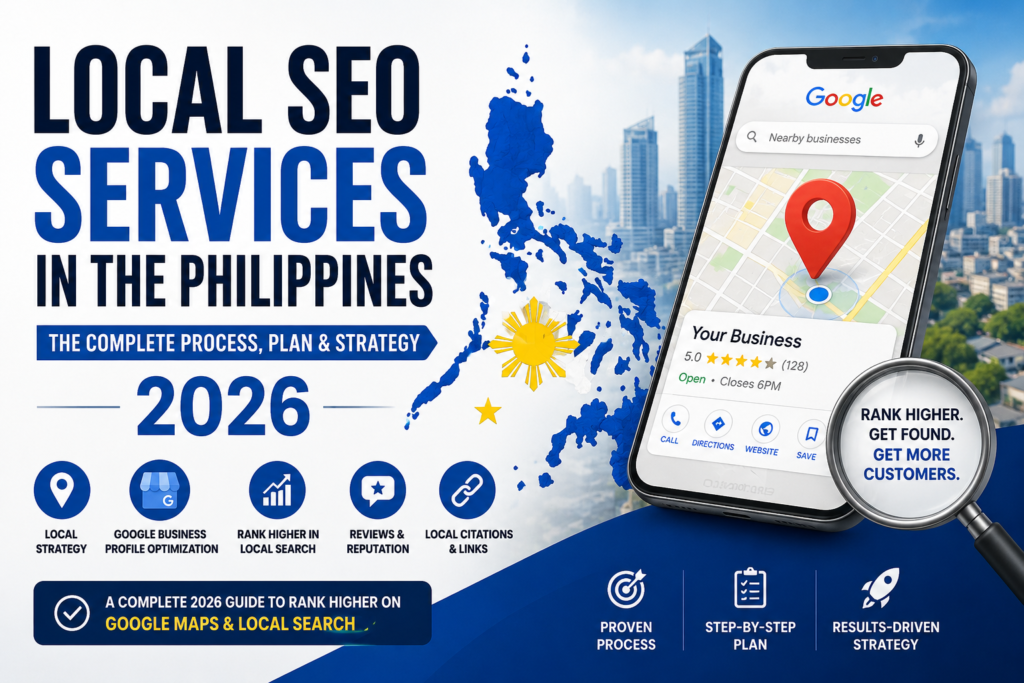
Local SEO is the process of getting your business to show up when nearby customers search on Google — in the Maps pack, in “near me” results, and on the first page for your city or barangay. For Philippine businesses, an effective local SEO service follows a clear process: audit → optimize your Google Business Profile → fix on-page and technical issues → build local citations and reviews → earn local links → then measure and repeat. Done right, you can expect to see movement in the Map pack within 60–90 days, with stronger, compounding results from month three onward.
If you’d rather have this handled for you, that’s exactly what my Local SEO Services are built for.
Why Local SEO Matters More Than Ever in the Philippines
Here’s something I tell almost every business owner I talk to: your customers are not flipping through the Yellow Pages anymore, and they’re not driving around looking for signage. They’re holding a phone, and they’re typing things like:
- “plumber near me”
- “dental clinic Calapan”
- “best malabanan service Quezon City”
- “hardware store open now”
- “resort near Puerto Galera”
The Philippines is one of the most mobile-first, social-first markets in the world. Most local searches happen on a phone, and a huge share of them carry buying intent — someone searching “near me” usually wants to call, message, or visit today. When your business shows up at the top of that search and your competitor doesn’t, you win the customer before they even compare prices.
That’s the entire game of local SEO: being the obvious, trusted choice at the exact moment someone in your area is ready to buy.
What Local SEO Actually Includes
A lot of people think local SEO is just “claiming your Google listing.” That’s the starting line, not the finish. A real local SEO service works across several connected areas:
- Google Business Profile (GBP) — your single most powerful local asset
- On-page local SEO — service pages, location pages, and content built around how locals search
- Technical SEO — making sure Google can crawl, index, and trust your site (and that it loads fast on mobile)
- Local citations & NAP consistency — your Name, Address, and Phone number listed identically across the web
- Reviews & reputation — the trust signals that influence both ranking and conversions
- Local link building — earning relevance and authority from the right local sources
The businesses that win are the ones that treat these as one system, not isolated checklist items.
My Local SEO Process (Step by Step)
This is the same framework I use whether I’m working with a service business in Oriental Mindoro or a clinic in Metro Manila. I keep it simple and repeatable on purpose.
Step 1 — Local SEO Audit & Competitor Research
Before changing anything, I look at where you actually stand. That means checking how your site is performing technically, how your Google Business Profile compares to competitors, where your NAP details appear (and where they conflict), and which keywords your top local competitors are ranking for. I also run a Map pack grid scan to see exactly how visible you are at different points around your service area — not just from your own address. You can’t fix what you haven’t measured.
Step 2 — Keyword & Intent Mapping
Next, I map out the searches that actually bring in customers. There’s a big difference between “what is teeth cleaning” (information) and “teeth cleaning near me” (ready to book). I prioritize the high-intent, location-based keywords — combining your services with cities, barangays, and “near me” variations — and map each one to a specific page on your site so nothing competes against itself.
Step 3 — Google Business Profile Optimization
This is where local SEO is won or lost. I make sure your profile is fully claimed and verified, the right primary and secondary categories are set, your description is keyword-relevant, your hours and service areas are accurate, and your products/services are listed out. I also set up Google Posts, add real photos, and turn on messaging where it makes sense. An optimized GBP often produces the fastest visible wins.
Step 4 — On-Page & Local Content
I optimize your core pages — titles, meta descriptions, headings, and content — around the keywords mapped in Step 2. For businesses serving multiple areas, I build proper location pages (one strong page per real service area, not thin duplicates). I also add the content that local customers actually want: clear services, pricing guidance where appropriate, FAQs, and trust elements.
Step 5 — Technical SEO
A beautiful site that loads slowly or can’t be crawled won’t rank. I check site speed (especially on mobile), mobile usability, indexing, internal linking, schema markup (LocalBusiness, FAQ, Review), and security headers. These are often the quiet issues holding a site back — I see missing or misconfigured technical basics on the majority of sites I audit.
Step 6 — Citations, NAP Consistency & Reviews
I make sure your business is listed accurately across relevant directories with one consistent NAP. Inconsistent details (an old address, a different phone number) confuse Google and erode trust. Alongside this, I set up a simple, ethical system to consistently earn genuine customer reviews — and to respond to them, because responses matter too.
Step 7 — Local Link Building & Authority
Finally, I work on earning relevance and authority from local and industry-relevant sources: local partnerships, organizations, suppliers, sponsorships, and genuinely useful content that other sites want to reference. This is the long-game work that separates businesses that rank temporarily from ones that hold the top spot.
Step 8 — Track, Report & Refine
Local SEO isn’t “set and forget.” I track keyword rankings, Map pack visibility, GBP insights (calls, direction requests, clicks), and traffic — then refine based on what the data shows. Every month builds on the last.
A Realistic 90-Day Local SEO Plan
Here’s how that process usually unfolds in the first three months. Local SEO is a compounding investment — the early weeks are about building the foundation, and the results accelerate after that.
Month 1 — Foundation
- Complete local SEO audit, competitor analysis, and Map pack grid scan
- Keyword and intent mapping
- Full Google Business Profile optimization
- Fix the most critical technical issues
- Clean up and correct NAP across major listings
What to expect: early Map pack movement, a more complete and trustworthy profile, and a clear baseline.
Month 2 — Optimization
- Optimize core service and location pages
- Add or improve local content and FAQs
- Implement schema markup
- Start the review-generation system
- Begin citation building
What to expect: improving rankings on mapped keywords, more profile interactions (calls, directions), and steadier traffic growth.
Month 3 — Authority & Momentum
- Local link building and partnerships
- Expand content around additional keywords and areas
- Continue earning and responding to reviews
- First full performance review and refined roadmap
What to expect: stronger, more stable Map pack presence, growth in qualified leads, and a clear picture of which levers to push next.
From month four onward, it’s about consistency: more reviews, more local content, more authority, and continuous refinement. That’s how a business goes from “showing up sometimes” to “the default choice in the area.”
The Strategy Behind It All
Tactics are the what. Strategy is the why. Here are the principles that guide every local SEO engagement I take on.
1. Relevance, distance, and prominence. Google ranks local results on three things: how relevant you are to the search, how close you are to the searcher, and how prominent (well-known and well-reviewed) your business is. Almost everything in local SEO maps back to strengthening one of these three.
2. Win the high-intent searches first. I’d rather rank you #1 for “[your service] + [your city]” than chase vanity keywords with no buyers behind them. Intent over volume, always.
3. Build trust signals, not tricks. Genuine reviews, consistent information, real photos, accurate hours, fast pages. Google rewards businesses that are actually trustworthy — so we make you genuinely trustworthy, not just look it.
4. Mobile and “near me” are the default. In the Philippines, your site has to be fast and effortless on a phone, and your profile has to be ready for someone who wants to call or get directions in one tap.
5. Don’t ignore AEO. Search is changing — AI overviews and answer engines increasingly surface businesses directly. Clear answers, structured content, FAQs, and proper schema help you show up in these newer results, not just the classic blue links. (It’s also why this very post leads with a Quick Answer.)
6. Consistency beats intensity. A business that shows up steadily — fresh posts, new reviews, ongoing content — will outrank one that did a big push once and went quiet. Local SEO rewards the marathon runner.
Local SEO for Common Philippine Business Types
The process is the same, but the emphasis shifts depending on your industry:
- Home & trade services (malabanan, plumbing, aircon, electrical) — heavy on “near me” + city keywords, fast response, and reviews. Speed-to-call wins jobs.
- Clinics & professionals (dental, derma, law, accounting) — trust and reputation are everything; reviews, credentials, and clear service pages carry the most weight.
- Retail & hardware stores — accurate hours, “open now” readiness, products listed on GBP, and strong Maps presence.
- Resorts, cafés & hospitality — photos, reviews, and ranking for both branded and “near [landmark]” searches matter most.
- Multi-branch businesses — a proper location-page structure plus one optimized GBP per real branch.
Common Local SEO Mistakes I See
A few patterns come up again and again — avoid these and you’re already ahead of most competitors:
- Claiming the Google profile but never optimizing or updating it
- Inconsistent NAP details scattered across old listings
- Thin, duplicated “location pages” that add no real value
- Ignoring reviews — both gathering them and replying to them
- A slow, clunky website on mobile
- Chasing traffic instead of leads
- Doing one burst of work and then going silent
How to Measure Success
Don’t get distracted by vanity metrics. The numbers that actually matter for local SEO are:
- Map pack rankings for your priority keywords across your service area
- GBP actions — calls, direction requests, website clicks, and messages
- Local organic traffic to your service and location pages
- Leads and conversions — the calls, bookings, and inquiries that turn into revenue
Rankings are the means. Leads are the goal.
Frequently Asked Questions
How long does local SEO take to show results in the Philippines? Most businesses see initial Map pack movement within 60–90 days, with stronger, compounding results from month three onward. Highly competitive areas and industries take longer.
Is local SEO worth it for a small business? Yes — arguably more so for small businesses, because local SEO levels the playing field. You’re competing within your area, not against national giants, and a well-optimized profile plus a solid site can outrank much larger competitors locally.
Do I need a website, or is a Google Business Profile enough? A GBP alone can get you started, but a fast, well-optimized website dramatically strengthens your rankings, builds trust, and gives you control over your own platform. The two work best together.
How much do local SEO services cost in the Philippines? It varies with your industry, competition, and number of locations. The right approach is to scope the work to your goals rather than quote a flat number blindly — which is why I always start with an audit and a conversation about your business.
Can I do local SEO myself? You can handle the basics — claiming your profile, gathering reviews, keeping your details consistent. The deeper work (technical fixes, content strategy, link building, ongoing optimization) is where most owners run out of time, and where a specialist pays for itself.
Ready to Dominate Local Search?
If your customers are searching nearby and finding your competitors instead of you, that’s a fixable problem — and it’s the exact work I do every day for businesses across the Philippines.
I’ll start with an honest audit of where you stand, show you the biggest opportunities, and build a plan around your actual goals.
👉 Get in touch here or learn more about my Local SEO Services, and let’s get your business showing up where it counts.