How to Become an SEO Specialist in the Philippines: A Step-by-Step Roadmap (2026)
To become an SEO specialist in the Philippines, you do not need a marketing degree. Learn how search engines work, master the four core disciplines (technical, on-page, off-page, and local SEO), get hands-on with tools like Google Search Console and a crawler such as Screaming Frog, then practice on a real website to build a results-based portfolio. Most committed beginners reach job-ready fundamentals in 3–6 months of consistent study and practice, and land their first paid client or junior role soon after.
One of the most common questions I get from aspiring freelancers at meet-ups and webinars across the Philippines is some version of: “Do I need a degree to do this?” The short answer is no. Some of the most capable SEO specialists I know are self-taught — they learned the fundamentals online, practiced on real websites, and built a portfolio that did the talking for them.
This guide is the step-by-step roadmap I wish someone had handed me earlier. It is written for Filipinos who want to break into SEO — whether your goal is a remote job with an international company, freelance work, or eventually running your own agency. For the wider picture on the role, demand, and salary, start with my complete 2026 SEO Specialist Philippines guide, then come back here for the how-to.
- No degree is required — SEO is a skills-and-proof industry, not a credentials one.
- Master the four core disciplines: technical, on-page, off-page, and local SEO.
- Hands-on practice on a real website matters more than any course or certificate.
- A portfolio that shows measurable results (traffic, rankings, leads) is your strongest asset.
- Expect 3–6 months to reach job-ready fundamentals with consistent effort.
- In 2026, AI literacy (AEO and GEO) is what separates a beginner from a standout candidate.
What is an SEO specialist? An SEO specialist is a digital marketing professional who improves a website’s visibility in search engines — and increasingly in AI-powered answer platforms — through keyword research, content optimization, technical fixes, and link building. In the Philippines, SEO specialists work as in-house staff, agency employees, freelancers, and consultants serving both local and international clients.
Do You Need a Degree or Certification to Become an SEO Specialist?
No, you do not need a college degree to become an SEO specialist in the Philippines. SEO is a meritocracy: employers and clients care about whether you can grow organic traffic and generate leads, not which course you graduated from. A relevant background in marketing, communications, IT, or writing can help, but it is never a requirement.
Certifications carry the same logic. A certificate from Google, HubSpot, or Semrush proves you understand the fundamentals, and it looks good on a résumé or profile — but it will never outweigh a portfolio that shows real results. Treat certifications as a useful starting checkpoint, not the finish line.
How Long Does It Take to Become an SEO Specialist?
With consistent study and hands-on practice, most beginners reach job-ready fundamentals in about three to six months. Becoming a confident, well-rounded specialist who can run full campaigns usually takes one to two years of real project experience. SEO rewards patience: the discipline is cumulative, and your judgment sharpens every time you watch a change you made move the numbers weeks later.
How to Become an SEO Specialist in the Philippines: 8 Steps
Here is the practical, ordered roadmap. Work through the steps in sequence — each one builds on the last.
Learn how search engines work
Before tactics, understand the foundation: how search engines crawl, index, and rank pages. Start with Google’s free Search Central documentation and SEO Starter Guide. Once you grasp crawling, indexing, and ranking signals, everything else in SEO makes far more sense.
Master the four core disciplines
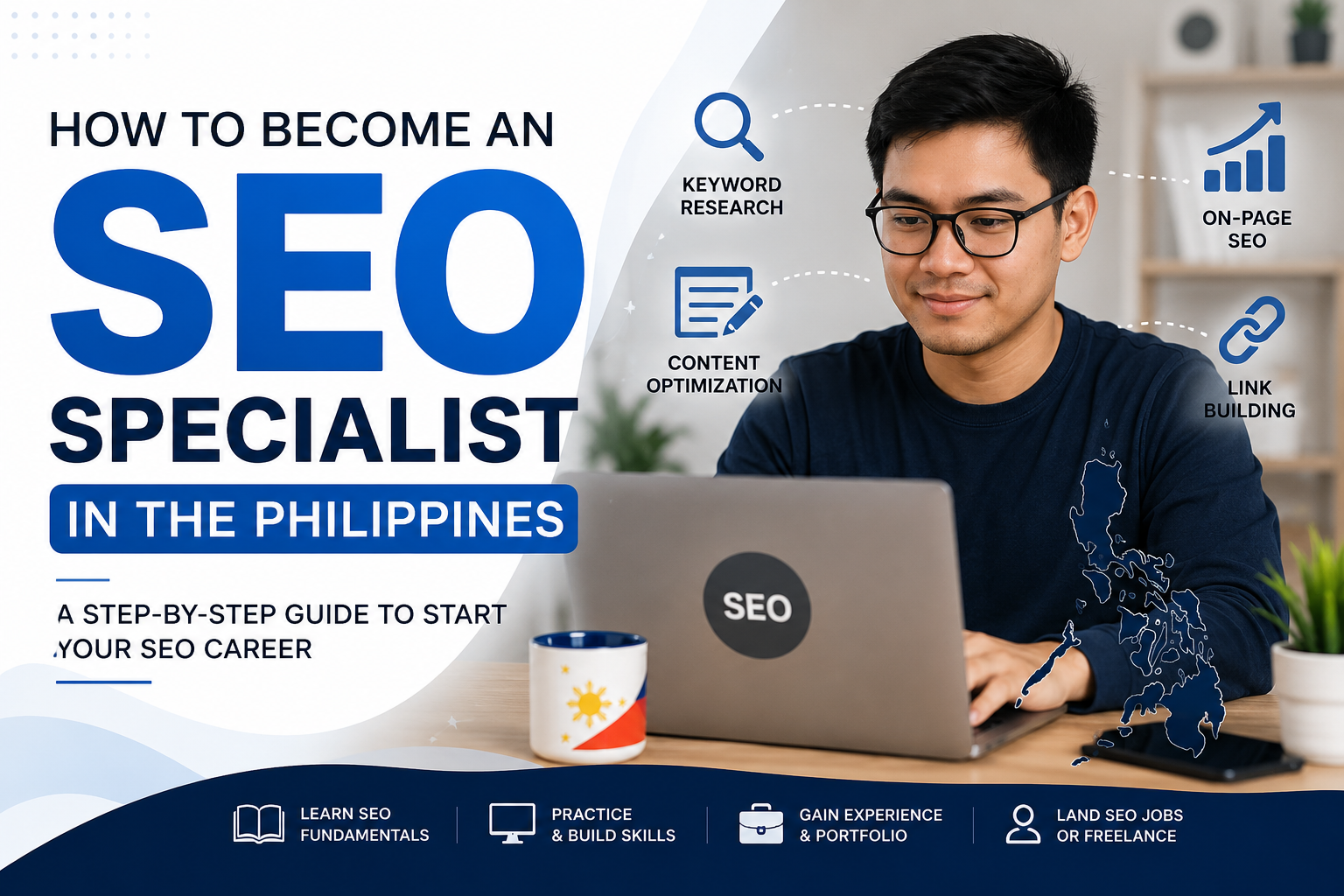
Modern SEO has four pillars you must understand: technical SEO (site speed, crawlability, indexing, structured data), on-page SEO (keywords, content, headings, internal links), off-page SEO (backlinks and digital PR), and local SEO (Google Business Profile and citations). Learn what each one does and how they reinforce each other. New to the jargon? My SEO glossary defines the core terms in plain language.
Get hands-on with the essential tools
You learn SEO by using its tools, not by reading about them. Set up Google Analytics 4 and Google Search Console (both free) on a site you control, then explore a crawler like Screaming Frog and a research suite such as Semrush or Ahrefs. Knowing how to pull and read this data is what separates practitioners from people who only know theory.
Practice on a real website
Build your own site or blog and optimize it from scratch. Pick a topic you know, publish content, fix technical issues, and watch what moves in Search Console over the following weeks. Learning SEO is like learning to ride a bicycle — reading helps, but mastery only comes from doing. Your own site doubles as your first portfolio piece.
Earn a certification (optional)
Free certifications from Google (Analytics, Digital Garage), HubSpot, and Semrush validate your fundamentals and give structure to your learning. They are optional, but they help when you have no client work yet and need something credible on your profile.
Build a results-based portfolio
Clients and employers want proof. Document measurable outcomes from your practice projects — organic traffic growth, ranking improvements, and lead generation — using screenshots, before-and-after data, and short case studies. A portfolio that shows results will always beat one that only lists skills.
Land your first client or job
Start with low-risk wins: volunteer to optimize a friend’s or family business’s website, take small freelance gigs on Upwork or OnlineJobs.ph, or apply for junior SEO roles at agencies. Your first project does not need to pay well — it needs to give you real data and a testimonial. If freelancing is your goal, my guide on what clients look for in an SEO consultant shows you exactly what to deliver.
Never stop learning
Google updates its algorithm thousands of times a year, and AI-powered search is reshaping how people find information. Follow Google Search Central, Search Engine Journal, and Search Engine Land, join active SEO communities, and keep experimenting. The specialists who thrive are the ones who treat learning as a permanent part of the job.
Free vs. Paid Resources for Learning SEO
You can learn the fundamentals of SEO for free. Paid resources mainly buy you speed, structure, and better tools — not secret knowledge.
| Resource type | Free options | Paid options |
|---|---|---|
| Fundamentals | Google Search Central, SEO Starter Guide, YouTube | Structured courses (Udemy, Coursera) |
| Tools | Google Analytics 4, Search Console, Screaming Frog (free tier) | Semrush, Ahrefs, full Screaming Frog license |
| Certifications | Google Digital Garage, HubSpot Academy | Semrush Academy paid tracks, specialized bootcamps |
| Community | Reddit, Facebook SEO groups, local meet-ups | Paid masterminds and mentorships |
My honest advice: start entirely free, prove to yourself that you enjoy the work, and only spend money on paid tools once you have real projects that justify the cost.
Freelance vs. Employed SEO Specialist: Which Path Should You Choose?
In the Philippines, you can build an SEO career on either path — or move between them as you grow. Here is how they compare for someone starting out.
| Employed (in-house or agency) | Freelance | |
|---|---|---|
| Best for | Beginners who want mentorship and steady income | Self-starters who want flexibility and higher ceilings |
| Income | Stable monthly salary | Variable, but uncapped with international clients |
| Learning | Structured, with senior guidance | Self-directed; you learn by solving everything yourself |
| Risk | Lower; predictable | Higher early on; you build your own pipeline |
Many Filipino specialists start employed at an agency to learn the craft and gain mentorship, then transition to freelancing or consulting once they have results and confidence. For a breakdown of what each path pays, see the salary section of my 2026 SEO Specialist guide.
Common Mistakes Beginner SEO Specialists Make
- Collecting courses instead of doing the work. No course replaces optimizing a real website and watching the data respond.
- Chasing rankings over results. Traffic and leads matter to clients far more than a single keyword’s position.
- Using risky shortcuts. Bought links and bulk backlinks can get a site penalized and your reputation with it.
- Ignoring technical SEO. Great content cannot rank on a site search engines struggle to crawl.
- Failing to document results. If you cannot show what you achieved, you cannot prove your value to a client or employer.
What Will Make You Stand Out as an SEO Specialist in 2026?
In 2026, the biggest differentiator is AI literacy. Search is expanding beyond traditional results into AI-generated answers, which means specialists now need to understand Answer Engine Optimization (AEO) and Generative Engine Optimization (GEO) — structuring content so AI platforms can confidently cite and recommend it. Combine that with strong analytical thinking, clear communication, and a habit of continuous learning, and you will stand apart from beginners who only know the basics.
Want a Head Start?
I regularly speak and run sessions on SEO and virtual assistance for the Filipino freelancing community. If you are building your SEO career, explore my workshops or reach out — I am always happy to point aspiring specialists in the right direction.
Frequently Asked Questions
Can I become an SEO specialist in the Philippines without a degree?
Yes. SEO is a skills-based field, and many successful Filipino specialists are self-taught. Employers and clients prioritize a portfolio of measurable results over formal credentials, so practical experience matters more than a diploma.
How long does it take to learn SEO well enough to get paid?
With consistent effort, most beginners reach job-ready fundamentals in three to six months and can take on small paid projects soon after. Becoming a confident, full-campaign specialist typically takes one to two years of real experience.
What is the best way to practice SEO as a beginner?
Build and optimize your own website or blog. It gives you a safe environment to apply keyword research, on-page work, and technical fixes, lets you watch real data in Google Search Console, and becomes your first portfolio piece.
Do I need to pay for tools like Ahrefs or Semrush to start?
No. You can learn the fundamentals using free tools such as Google Analytics 4, Google Search Console, and the free tier of Screaming Frog. Invest in paid suites only once you have real projects that justify the cost.
Is freelancing or employment better for a beginner SEO specialist?
Employment at an agency offers mentorship and steady income, which suits most beginners. Freelancing offers flexibility and a higher earning ceiling but requires you to build your own client pipeline. Many specialists start employed and move to freelancing once they have proven results.
What skills should I prioritize to stand out in 2026?
Prioritize the four core SEO disciplines, data analysis, and clear communication, then add AI literacy — specifically Answer Engine Optimization (AEO) and Generative Engine Optimization (GEO) — which are quickly becoming standard expectations for modern SEO roles.