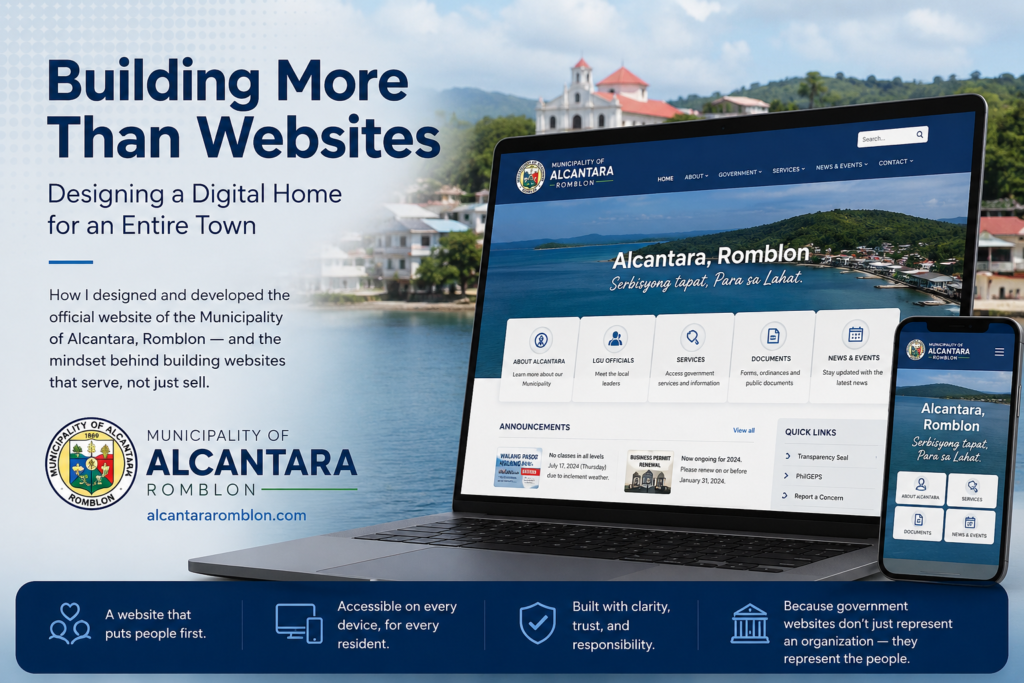
When people think about my work, they usually picture SEO campaigns and websites for businesses. But one of the projects I’m most proud of isn’t a business at all — it’s a local government unit. I had the opportunity to design and develop the official website of the Municipality of Alcantara, Romblon (alcantararomblon.com), and in this post I want to walk you through how I approached it and what went into building a proper digital home for an entire town.
Government websites come with a different kind of responsibility. A business website needs to sell. A government website needs to serve — every resident, of every age, on every kind of device, often when they need help the most. That shift in mindset shaped every decision I made on this project.
Project at a Glance
- Client: Municipality of Alcantara, Romblon (Local Government Unit)
- Project type: Official government website — design and development
- Platform: WordPress + Elementor
- Scope: Information architecture, design, development, content structuring, and citizen-service features
- Goal: A single, trustworthy digital hub for local information, transparency, and frontline services
- Theme of the project: Responsive governance — the new digital home of Alcantara
A Little About Alcantara
Alcantara is the 13th municipality of the province of Romblon, sitting on the southeastern coast of Tablas Island. It’s a coastal, agriculture-and-commerce town with a strong sense of identity — from its Saginyogan Festival to its proud Alcantaranhons. Being from the MIMAROPA region myself, working on a project this close to home, for a community in our own island group, made it especially meaningful.
The municipality already had a clear vision: an economically sustained, God-loving, educated, and healthy community living under responsive governance. My job was to take that vision and give it a digital expression that residents could actually use.
The Challenge: Why an LGU Needs a Real Website
A lot of local governments in the Philippines still rely entirely on a Facebook page for public communication. Facebook is great for reach, but it has real limits for governance:
- Important documents get buried in the timeline within days
- There’s no proper structure for transparency reports, ordinances, or the Citizen’s Charter
- Citizens can’t reliably find emergency hotlines, office directories, or service procedures when they need them
- It isn’t a permanent, official, searchable record the municipality fully controls
The challenge was to build something that complements their social media presence while giving Alcantara a permanent, organized, and authoritative platform — one that meets the expectations of modern, transparent governance.
Step 1 — Discovery and Understanding the Mandate
I started not with design, but with understanding. A municipal website isn’t a single product — it’s the public face of more than a dozen offices, each with its own mandate, documents, and services. Before drawing a single layout, I mapped out what the LGU is actually required and expected to publish, including:
- The Citizen’s Charter (a public pledge of frontline service standards)
- Full Disclosure Policy documents — budgets, procurement plans, financial statements
- The directory of officials, departments, and employees
- Emergency and disaster-response information
- Business, tourism, and citizen services
Understanding these obligations first meant the structure could be built around real governance needs — not just what looks nice on a homepage.
Step 2 — Information Architecture
This was the heart of the project. With this much content, organization is everything. A resident should be able to land on the site and find what they need in two or three clicks, whether that’s a department, a document, or a hotline.
I organized the entire site into clear, intuitive pillars:
- About — Municipal Profile (History, Demographics, Geography, Economy) and the Directory of Officials & Employees
- Governance — Offices of the Mayor and Vice Mayor, the Sangguniang Bayan, all municipal departments, executive orders, and resolutions
- Transparency — Citizen’s Charter, ordinances, the Full Disclosure Policy, awards, and the Bids and Awards Committee
- Business — permits and licensing, how to apply, the local revenue code, and investment opportunities
- Tourism and Environment — tourist attractions, events and festivals, tourism development, and environmental programs
- Services — citizen services, job opportunities, scholarships, and senior citizen & PWD programs
- Contact Us
Each municipal department got its own dedicated page — Planning, Budget, Treasurer, Accountant, HR, Agriculture, Health, Social Welfare, MDRRMO, Engineering, Civil Registrar, and the Assessor’s Office — so every office has a clear home online.
Step 3 — Choosing the Right Platform
I built the site on WordPress with Elementor, and that was a deliberate choice for a government client. An LGU needs a platform that is:
- Maintainable by non-technical staff — content can be updated without a developer for every change
- Flexible — able to handle dozens of pages, document libraries, and growing content
- Cost-effective and sustainable — no expensive proprietary licenses, with a huge support ecosystem
- Secure and well-supported — a mature platform that won’t be abandoned
WordPress hits all of those, which matters a lot when you’re handing a site over to a team that needs to keep it alive long after launch.
Step 4 — Building the Citizen-Focused Features
Beyond the standard pages, I built features specifically around how residents actually use a government site — often in a hurry, often on a phone.
Emergency Hotlines, front and center. I made the municipality’s emergency contacts easy to reach — BFP, MDRRMO, PNP, and the RHU, plus direct hotline numbers for every single barangay, from Poblacion to Tugdan. On a phone, these are tap-to-call. When there’s a typhoon or an emergency, no one should be hunting through menus.
Live weather monitoring. Romblon is an island province that takes the full force of the typhoon season, so I integrated a live Windy weather map centered on Alcantara. Residents can check wind and weather conditions directly from the official site.
News and updates that stay current. Rather than asking staff to manually post every announcement twice, I integrated the municipality’s official Facebook feeds so the latest news flows automatically onto the website — combining the reach of social media with the permanence of an official site.
A featured gallery. I built a photos-and-videos section to showcase community life and events like the Saginyogan Festival, including the festival’s competing tribus. It gives the site warmth and reflects the town’s identity, not just its bureaucracy.
Transparency by design. The Full Disclosure Policy section, Citizen’s Charter, and Freedom of Information links were given proper, permanent structure — making it genuinely easy for citizens to hold their government accountable, which is exactly the point.
Step 5 — Mobile-First, Because That’s How Filipinos Browse
The majority of Filipinos access the internet primarily through their phones, and in a rural municipality that’s even more true. Every layout, menu, and feature was built to work cleanly on mobile first — fast-loading, tap-friendly, and readable on a small screen. The site is also configured to behave like a web app on mobile, so it feels native and accessible.
A government website that only works well on a desktop is a government website most of its citizens can’t actually use.
Building for Transparency and Trust
What I kept coming back to throughout this project is that a government website carries a weight a commercial site doesn’t. It’s an instrument of public trust. Every design choice — clear navigation, accessible documents, visible service standards, a published Citizen’s Charter — is really a statement that this is a government that wants to be found, understood, and held accountable.
That’s why I treated structure, clarity, and transparency as the real deliverables, with the visual design serving those goals rather than the other way around.
What This Means for Alcantara
The result is a single, official digital home for the municipality — one that:
- Gives residents reliable access to services, documents, and emergency information
- Puts transparency front and center, in line with the standards of responsive governance
- Presents Alcantara professionally to tourists, investors, and partner agencies
- Gives the LGU a permanent platform it fully owns and controls
- Strengthens the connection between the local government and the Alcantaranhons it serves
It’s a project that genuinely contributes to digital governance in our region, and that’s the kind of work I find most rewarding.
Lessons From Building a Government Website
A few things this project reinforced for me:
- Structure beats decoration. With hundreds of pieces of content, information architecture is the single most important design decision.
- Build for the worst moment, not the best. Emergency and disaster information has to be findable instantly — design around the citizen who’s panicking, not the one casually browsing.
- Sustainability matters. The best government site is one the staff can actually maintain after handover. Choosing the right platform is part of the design.
- Local context is everything. Weather integration, barangay-level hotlines, and festival galleries aren’t generic features — they exist because they matter to Alcantara specifically.
Need a Website for Your LGU, Office, or Organization?
Building the official website of the Municipality of Alcantara, Romblon was a real privilege, and it’s the kind of project I’d love to do more of. If you’re with a local government unit, a government office, or an organization that needs a professional, transparent, and citizen-friendly website — built to be maintainable and built for mobile — I can help.
👉 Take a look at my Website Design and Development services, browse my portfolio, or get in touch and let’s build something your community can rely on.