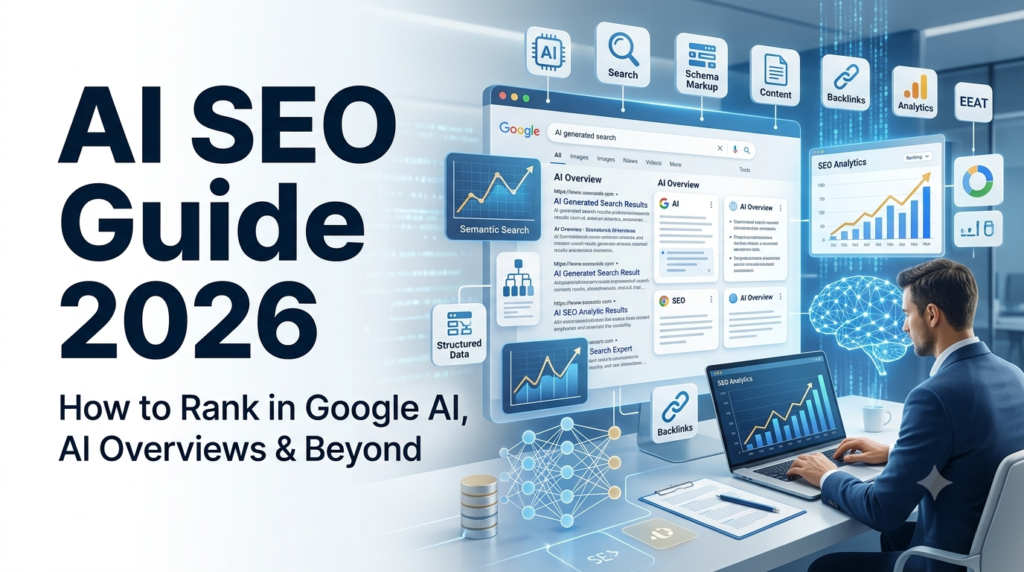
Search changed more in the last two years than in the previous decade. AI Overviews, Perplexity, and chat-based search are now a real part of how people find businesses — often without a single click to a website. This guide covers what AI SEO actually means in 2026, and what to do about it without abandoning the fundamentals that still drive traditional rankings.
TL;DR — The Short Version
- AI SEO is about being visible and cited in AI-generated answers, not just ranking in the traditional ten blue links.
- Structured data, clear entity signals, and answer-first content structure meaningfully improve your odds of AI citation.
- Traditional SEO fundamentals — technical health, authority, content depth — still matter and now feed AI visibility too.
- No one can guarantee inclusion in AI Overviews; the goal is improving the odds, not chasing a guarantee.
What’s Actually Changed
Google’s AI Overviews now appear across a large share of searches, often answering the query directly at the top of the page. Beyond Google, tools like ChatGPT, Perplexity, and Gemini are becoming genuine discovery channels — some users research a purchase decision entirely inside a chat interface before ever visiting a website. For businesses, this means visibility now has two layers: appearing in traditional organic results, and being the source an AI system cites or recommends.
Answer Engine Optimization (AEO) & Generative Engine Optimization (GEO)
Two terms are worth understanding heading into 2026. AEO focuses on structuring content so it directly answers specific questions — clear headers, concise answers up front, and well-organized FAQ sections. GEO is broader: earning the kind of entity-level authority and citation-worthy content that gets referenced by generative AI systems, not just search engines.
What Actually Improves AI Search Visibility
- Answer-first content structure — state the direct answer clearly before elaborating.
- Structured data (FAQ, HowTo, Organization, Product schema) that helps machines parse your content’s meaning.
- Clear entity signals — consistent naming, author information, and organizational details across your site.
- Original data, insights, or experience that AI systems can’t get from ten other sites saying the same thing.
- Strong E-E-A-T signals: genuine expertise, clear authorship, and demonstrable experience.
- Solid technical SEO — AI systems still rely on crawlable, well-structured, fast-loading sites.
AI Search vs. Traditional SEO — Where They Overlap
| Factor | Still Matters for Traditional SEO | Matters for AI Search Too |
| Technical health & crawlability | Yes | Yes |
| Backlink authority | Yes | Indirectly, via trust signals |
| Structured data / schema | Helps rich results | Directly helps AI parsing |
| Answer-first content structure | Helps dwell time & featured snippets | Directly helps AI citation |
| Fresh, original content | Helps rankings over time | Increases citation likelihood |
A Practical AI SEO Checklist for 2026
- Audit your top pages for clear, answer-first structure — can a reader (or an AI) get the core answer in the first two sentences?
- Implement or validate FAQ, HowTo, and Organization schema across key pages.
- Ensure author and business information is clear, consistent, and verifiable across your site.
- Track brand mentions and citations across AI tools, not just traditional rank tracking.
- Keep investing in traditional SEO fundamentals — AI search visibility is built on top of them, not instead of them.
Frequently Asked Questions
What is AI SEO?
AI SEO is the practice of optimizing your website and content to be visible, cited, or recommended within AI-generated search results and chat-based tools, in addition to traditional organic rankings.
Does AI SEO replace traditional SEO?
No. Traditional technical, content, and authority fundamentals remain the foundation. AI SEO adds an additional layer of structure and clarity on top of that foundation.
Can I guarantee my business shows up in AI Overviews?
No one can guarantee inclusion in AI-generated results, but structured, authoritative, answer-first content significantly improves your odds.
Is AI SEO relevant for small, local businesses?
Yes — local and service businesses are already appearing in AI-generated local search summaries, making early adaptation a genuine advantage.
How do I measure AI search visibility?
Through a combination of manual testing across AI tools, monitoring brand mentions and citations, and emerging AI-visibility tracking tools as they mature.
Want an assessment of how visible your business is across AI search today?