
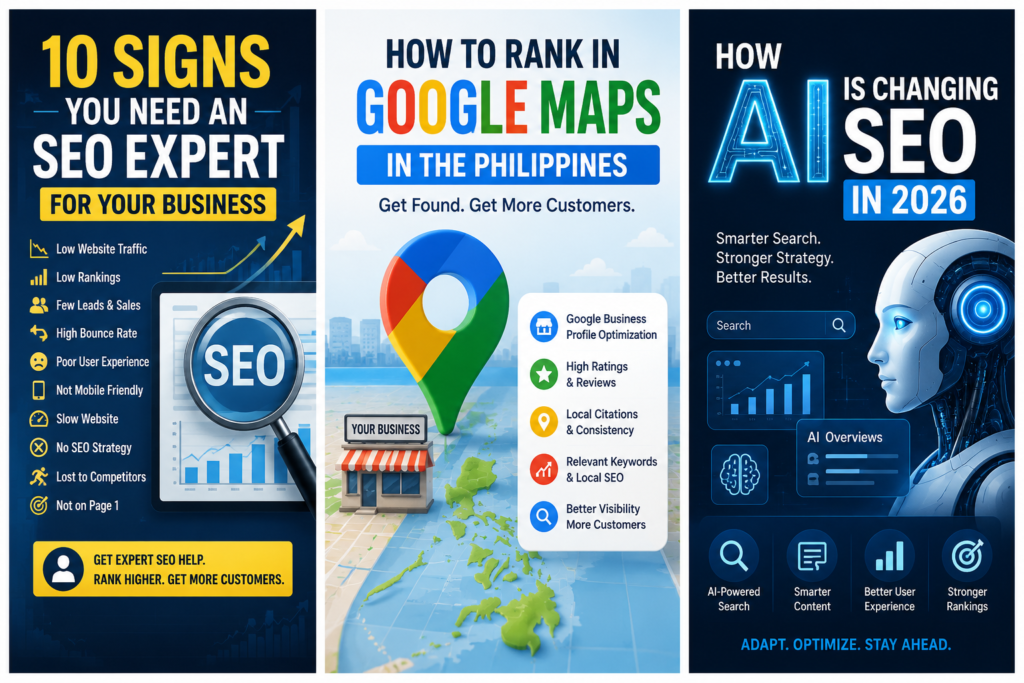
To rank in Google Maps in the Philippines, optimize a complete and active Google Business Profile, earn genuine reviews, and build consistent local citations. Google ranks local results on three factors — relevance, distance, and prominence — and your Business Profile is the foundation for all of them. When someone in Makati, Cebu, or your own city searches for what you offer, the top three Map results capture most of the clicks. This guide shows you how to earn one of those spots.
The three factors Google uses to rank local results
Google’s own documentation is refreshingly clear: local rankings come down to relevance, distance, and prominence.
| Factor | What it means | Can you influence it? |
|---|---|---|
| Relevance | How well your profile matches the search | Strongly — through categories, keywords, and complete info |
| Distance | How close you are to the searcher | Mostly fixed by your location |
| Prominence | How well-known and trusted your business is | Strongly — through reviews, citations, and links |
Distance is largely out of your hands, so the real work is improving relevance and prominence. Everything below targets those two levers.
Step 1: Claim and verify your Google Business Profile
An unclaimed profile is a liability — anyone, including competitors, can suggest edits Google may accept. Claim and verify yours immediately. In the Philippines, postcard verification is often slow or unreliable, so use faster options when offered: video verification, phone, or email. Verification confirms your business is legitimate and unlocks full management.
Step 2: Choose the most specific primary category
This is the single highest-impact decision you will make. Your primary category tells Google which searches you are even eligible for. Specificity wins: “Excavating Contractor” beats “Contractor,” and “Septic System Service” beats “Plumber” if that is your core offering. Add two or three secondary categories for other real services, but get the primary one exactly right.
Step 3: Complete every field and keep NAP consistent
Businesses with complete profiles rank better than those with gaps. Fill in your hours, website, phone number, address, description, services, and products. Just as important: your NAP — Name, Address, Phone number — must be identical everywhere it appears. If you are “Juan’s Aircon Services” on Google but “Juan Aircon Services Inc.” on a directory, Google may treat them as different businesses, diluting your authority.
Step 4: Earn and respond to genuine reviews
Reviews are one of the strongest prominence signals, and most Filipino customers read them before choosing. What matters is quantity, recency, and diversity. Build a simple habit:
- Ask happy customers for a review right after a good experience.
- Make it effortless with a direct review link (share it via Messenger, SMS, or your receipt).
- Reply to every review — thank the positive ones, and respond to negatives calmly with an apology and a fix, moving details to a private channel.
Never buy fake reviews. It breaches Google’s policies and can get your profile suspended, erasing every other gain.
Step 5: Add real photos and post regularly
Profiles with high-quality, authentic photos rank and convert better than those with stock images or none at all. Show your actual location, team, work, and results. Short 10–30 second videos help you stand out in 2026 search. Posting regular Google updates — promos, projects, announcements — signals to Google that your business is active, which supports ranking.
Step 6: Build local citations in Philippine directories
Citations are mentions of your NAP on other sites — directories, local listings, industry databases. They are a classic prominence signal, and consistency is everything. List your business in trusted Philippine directories and keep the details identical to your Google profile. A mix of general and industry-specific listings gives you the broadest local footprint.
Step 7: Optimize your website for local intent
Your Map ranking is reinforced by your website. Use geo-specific, intent-based keywords in your pages, headings, and descriptions — the way people actually search (“aircon repair Calamba,” not just “aircon repair”). If you serve multiple areas, create a dedicated, genuinely unique page for each — never duplicated pages with the city name swapped, which Google treats as low-value. Mobile speed is non-negotiable: Philippine users spend hours online daily and overwhelmingly on phones.
Step 8: Earn local backlinks and community signals
Links from locally relevant sites carry outsized weight for Maps. Pursue mentions from regional news outlets, local business associations, community organizations, and industry groups. Sponsoring a local event or partnering with nearby businesses earns both backlinks and the community signals Google reads as trust.
A 2026 note: local SEO now includes AI search
Ranking in the Map pack is still the highest-ROI play for Philippine service businesses, but visibility now extends to AI-powered search. Customers increasingly ask Google’s AI Overviews and tools like ChatGPT and Gemini for local recommendations. The same foundations — a complete, consistent, well-reviewed profile and clear local content — are what make AI systems confident enough to surface your business too.
Frequently asked questions
What are the three factors Google uses to rank Google Maps results?
Relevance, distance, and prominence. Relevance is how well your profile matches the search, distance is how close you are to the searcher, and prominence is how trusted your business is. Distance is mostly fixed, so focus on relevance and prominence.
What is the most important Google Business Profile setting for ranking?
Your primary category. Choose the most specific one that matches your core business, because Google uses it to decide which searches you can appear in.
How can a Philippine business verify a profile faster?
Postcard verification can be slow here, so use video, phone, or email verification when offered.
Do reviews affect Google Maps ranking?
Yes — quantity, recency, and diversity of genuine reviews are strong signals. Ask regularly, make it easy, respond to all, and never buy fake reviews.