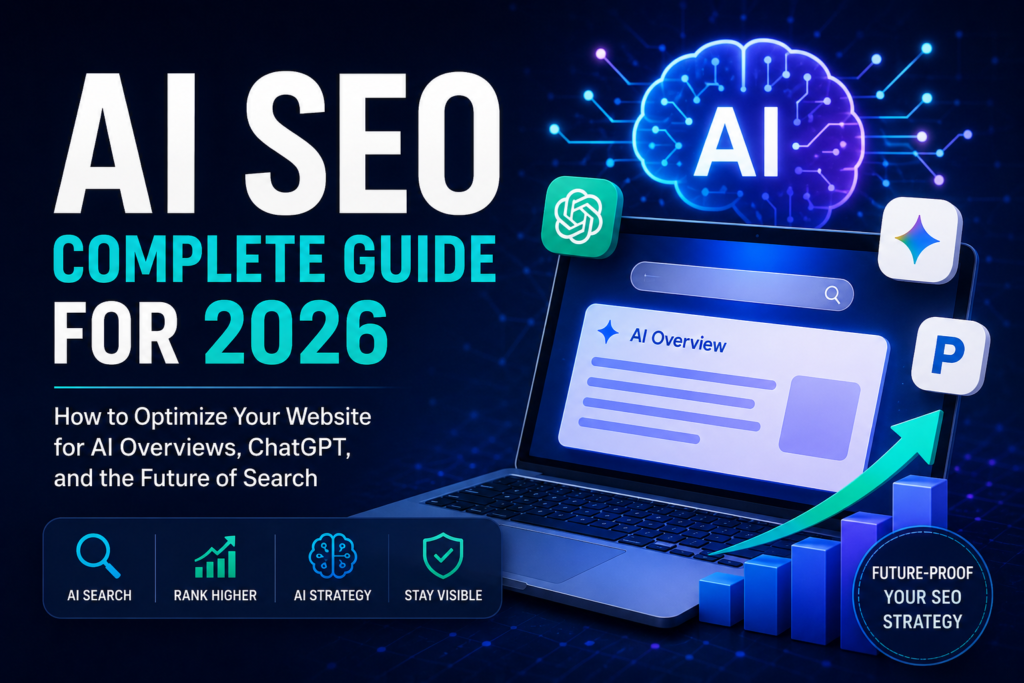
This guide explains what AI SEO actually means, how it’s different from traditional SEO, which tools matter, and how to build a strategy that keeps your business visible whether someone is searching on Google or asking an AI assistant directly.
What Is AI SEO?
AI SEO refers to the practice of optimizing content and websites to perform well in AI-powered search environments — including Google’s AI Overviews, AI chatbots like ChatGPT and Gemini, and answer engines like Perplexity — in addition to traditional organic search results.
It also includes using AI tools to make traditional SEO work faster and smarter: AI-assisted keyword research, content briefs, technical audits, and performance analysis.
In short, AI SEO has two sides:
- Optimizing for AI — making sure your content gets cited, summarized, or recommended by AI systems
- Optimizing with AI — using AI tools to execute SEO strategy more efficiently
Both matter. But it’s the first one — earning a citation inside an AI-generated answer — that will separate visible brands from invisible ones over the next few years.
Why AI SEO Matters in 2026
Search behavior has fundamentally shifted. A growing share of queries now get answered directly within AI Overviews or AI chat interfaces — meaning users may never click through to a website at all. Industry research on generative search consistently points to more searches ending in an instant, on-page answer rather than a traditional click-through, which is exactly why visibility inside the answer itself has become a metric worth tracking on its own. For businesses, this changes the goal from simply “ranking #1” to being the source AI systems trust enough to reference.
Key shifts driving the need for AI SEO:
- AI Overviews now appear across a large share of Google searches, often above traditional organic listings.
- Answer engines like ChatGPT and Perplexity are becoming a real discovery channel, especially for research-heavy and commercial queries.
- Zero-click searches are increasing, meaning visibility inside the answer itself matters as much as the click.
- E-E-A-T (Experience, Expertise, Authoritativeness, Trustworthiness) matters more than ever, since AI systems favor content that demonstrates real credibility.
- Searches are becoming conversational. Users increasingly type or speak full, natural-language prompts instead of fragmented keywords, which rewards content written to answer real questions rather than match exact-match phrases.
SEO vs. AEO vs. GEO vs. AI SEO: What’s the Difference?
You’ll increasingly see these terms used together — and sometimes interchangeably — but they’re not quite the same thing:
| Approach | Focus |
|---|---|
| SEO | Ranking in traditional search results |
| AEO (Answer Engine Optimization) | Appearing in answer engines and voice assistants |
| GEO (Generative Engine Optimization) | Optimizing content specifically for generative AI systems |
| AI SEO | Combining traditional SEO with optimization for AI-powered search experiences (an umbrella that includes AEO and GEO tactics) |
For most businesses, AI SEO is the practical, day-to-day umbrella — it doesn’t require picking one lane over another, since the underlying fundamentals of clarity, structure, and authority serve all three.
How AI Search Engines Choose What to Cite
AI systems don’t rank pages the same way traditional Google search does. Instead, they tend to favor content that is:
- Clearly structured with descriptive headers and direct answers near the top
- Factually accurate and well-sourced, often pulling from pages that already rank well organically
- Written in a natural, question-answering format rather than heavily keyword-stuffed copy
- Backed by authority signals — brand mentions, backlinks, and consistent expertise across the web
- Recently updated, since freshness is a strong trust signal for time-sensitive topics
AI SEO Strategy: The 6 Core Pillars for Success
1. Structured, Answer-First Content
Write content that answers the core question within the first few sentences of a section, then expands with supporting detail. This format is far more likely to be pulled into AI-generated summaries.
2. Strong Technical Foundations
AI crawlers and traditional search bots both rely on clean, crawlable, well-structured websites. Fast load times, clear site architecture, and proper schema markup remain essential — AI SEO doesn’t replace technical SEO, it builds on it. See our SEO services for how we approach the technical side.
3. Structured Data & Schema Markup
Implementing schema (FAQ, Article, Product, LocalBusiness, etc.) helps both traditional search engines and AI systems understand exactly what your content is about. See the schema markup included at the end of this post for a working example.
4. Topical Authority
Rather than publishing scattered, one-off articles, building comprehensive content clusters around your core services signals depth of expertise — something AI systems weigh heavily when deciding what to cite.
5. Brand Mentions Across the Web
AI models are influenced by how often and how consistently a brand is mentioned across the internet — not just backlinks. Digital PR, guest content, and consistent business listings all contribute.
6. E-E-A-T Signals
Author bios, credentials, real case studies, original data, and transparent business information all strengthen trust — both for human readers and AI evaluation systems.
Original data deserves special attention here. Generative engines are heavily biased toward citing whoever published a statistic or data point first — original research, proprietary case study numbers, and first-party survey results function as “citation bait” that AI systems reach for again and again once it enters circulation. If you have access to unique data from your own work, publishing it is one of the highest-leverage things you can do for long-term AI visibility. Our case studies are a good example of using real project data as trust signals.
AI SEO Best Practices
Beyond the core strategic pillars, these day-to-day habits keep your content performing well across both traditional and AI-driven search:
- Write for people first, AI second
- Demonstrate first-hand experience with real examples and case studies
- Use clear, descriptive H2 and H3 headings
- Answer questions directly before expanding on the topic
- Add schema markup to help search engines understand your content
- Update content regularly to reflect changes in AI search
- Build topical authority through related, interlinked articles
- Improve page speed and Core Web Vitals
- Earn authoritative backlinks and brand mentions
- Monitor your visibility in AI-generated answers
Best AI SEO Tools for 2026
| Tool Category | Examples | Use Case |
|---|---|---|
| AI Keyword Research | Keyword Insights, SEOwind | Finding intent-based keyword groups faster |
| Content Optimization | Surfer SEO, Frase, MarketMuse | Structuring content for both SEO and AI answer engines |
| Technical Auditing | Screaming Frog, Sitebulb | Identifying crawl, speed, and indexing issues at scale |
| AI Visibility Tracking | Profound, Peec AI, Otterly.AI | Measuring how often you appear in ChatGPT/AI Overview results |
| Schema Generators | Merkle Schema Generator, Rank Math, Yoast SEO | Implementing schema markup without manual coding |
AI tools should support your strategy, not replace human judgment — content that reads as obviously AI-generated, generic, or inaccurate tends to underperform in both traditional and AI-driven search.
AI SEO vs. Traditional SEO: What’s Different?
| Traditional SEO | AI SEO |
|---|---|
| Focused on ranking in the “10 blue links” | Focused on being cited/summarized by AI systems |
| Success measured mostly by clicks and rankings | Success also measured by AI visibility and brand mentions |
| Keyword optimization is central | Intent-matching, conversational prompt optimization, and answer clarity are central |
| Backlinks are the primary authority signal | Backlinks + brand mentions + E-E-A-T all matter |
Importantly, AI SEO doesn’t replace traditional SEO — it extends it. The fundamentals of good content, technical health, and authority building remain the foundation either way.
How to Get Started with AI SEO
- Audit your current content for structure — does it answer questions clearly and quickly?
- Add or improve schema markup across your key pages.
- Build topic clusters instead of isolated blog posts.
- Strengthen your author and business credibility signals (bios, case studies, testimonials).
- Monitor your visibility in AI answers, not just traditional rankings.
- Keep content updated — freshness matters more in an AI-driven search landscape.
Frequently Asked Questions
What is AI SEO in simple terms?
AI SEO is the practice of optimizing your website and content so it performs well in AI-powered search tools like Google AI Overviews, ChatGPT, and Perplexity — in addition to traditional search rankings.
Does AI SEO replace traditional SEO?
No. AI SEO builds on traditional SEO fundamentals like technical health, quality content, and backlinks, while adding a focus on structured, answer-first content that AI systems can easily cite.
What are the best AI SEO tools right now?
The most useful tools fall into five categories: AI-assisted keyword research (Keyword Insights, SEOwind), content optimization (Surfer SEO, Frase, MarketMuse), technical auditing (Screaming Frog, Sitebulb), AI visibility tracking (Profound, Peec AI, Otterly.AI), and schema markup generation (Rank Math, Yoast SEO).
How do I know if my content is showing up in ChatGPT or AI Overviews?
Dedicated AI visibility tracking tools can monitor how often your brand or content is referenced in AI-generated answers, though manual spot-checks with common queries are also useful. It’s worth noting that standard tools like Google Analytics largely miss this activity — they’re built to track human page visits, not the AI crawlers and agents (from providers like OpenAI or Anthropic) that fetch your pages to generate an answer elsewhere. Purpose-built tools such as Profound go a level deeper, mapping actual AI agent and bot activity on your site so you can see traffic that would otherwise stay invisible.
Is AI SEO worth it?
Yes, for most businesses. Since AI-generated answers are capturing a growing share of search attention, being cited or recommended by AI systems is becoming as valuable as ranking traditionally — and the underlying work strengthens your traditional SEO at the same time.
Can ChatGPT improve SEO?
ChatGPT and similar tools can speed up parts of the SEO process — keyword clustering, content outlines, meta description drafts — but the strategic decisions and quality control still need human expertise to avoid generic or inaccurate output.
Does Google penalize AI-generated content?
Google has stated it doesn’t penalize content simply for being AI-assisted; what it penalizes is low-quality, unhelpful content regardless of how it was produced. Content created or assisted by AI still needs to meet the same helpfulness and E-E-A-T standards as anything else.
What is the difference between AI SEO and traditional SEO?
Traditional SEO focuses on ranking in classic search results, while AI SEO extends that work to also target visibility inside AI Overviews, chatbots, and answer engines — using the same technical and content fundamentals as a base.
How does AI SEO affect local SEO?
AI-powered local answers increasingly pull from the same signals as traditional local SEO — Google Business Profile completeness, reviews, and NAP consistency — so a strong local SEO foundation directly supports AI visibility for local queries too.
What is Answer Engine Optimization (AEO)?
AEO is the practice of optimizing content specifically to appear in answer engines and voice assistants, focusing on concise, direct answers to common questions.
What is Generative Engine Optimization (GEO)?
GEO refers to optimizing content so it gets cited or summarized correctly by generative AI systems like ChatGPT, Gemini, and Perplexity.
About the Author
Alvin John Ferias is an SEO Specialist and Website Developer based in the Philippines. He has worked with businesses in Australia, the United States, and other international markets, helping improve organic visibility through technical SEO, content strategy, AI SEO, local SEO, and WordPress development. Learn more about Alvin or explore his portfolio and case studies.
Stay Ahead of the Search Curve
Ready to future-proof your organic visibility? Our AI SEO services combine technical SEO, content strategy, structured data, and AI search optimization to help businesses rank in Google Search, AI Overviews, ChatGPT, Gemini, and other emerging answer engines. Contact us today to discuss a tailored AI SEO strategy for your business.
This guide is part of our AI SEO content hub. Explore related resources: SEO Services · Website Design & Development · Local SEO Services · Case Studies · Blog · FAQ