
By Alvin John Ferias | SEO Specialist and Digital Marketing Consultant, Philippines
Last updated: November 6, 2026
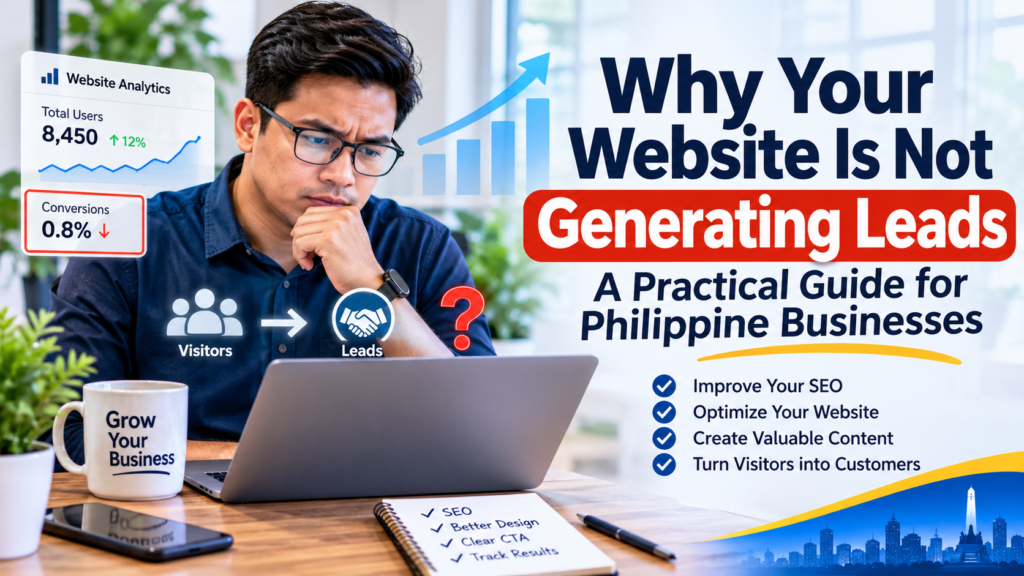
Your business has a website. You invested in its design, added your services, uploaded photographs, included your contact information, and probably shared the link on Facebook. But there is one problem: where are the customers?
If your website receives very few inquiries, phone calls, quotation requests, or sales, you are not alone. Many businesses in the Philippines have websites that look professional but fail to generate meaningful business opportunities. Some receive visitors who leave immediately, while others struggle to appear on Google when potential customers search for their products or services.
The reality is that a business website should do more than exist online. It should help attract potential customers, communicate your value, establish credibility, and encourage visitors to take action.
With more than 15 years of experience in SEO, web development, and digital marketing, I have seen how important it is to approach website development and search engine optimization as connected business strategies. A beautiful website without visibility is difficult to discover. A website with traffic but no clear conversion strategy can attract visitors without producing inquiries.
In this guide, I will explain why websites fail to generate leads and what Philippine businesses can do to turn their online presence into a more effective customer acquisition channel.
1. Why Having a Website Is No Longer Enough
Having a website used to give businesses a significant competitive advantage. Today, almost every established company, startup, freelancer, and small business can create an online presence. Customers have more choices, competitors are easier to discover, and expectations regarding website quality have increased. Simply publishing a homepage and listing your services will not automatically convince someone to contact you.
Think about how customers behave when they need a particular service. Someone looking for a plumbing contractor in Manila, an accounting firm in Cebu, or a web developer in Oriental Mindoro will probably search online, compare several providers, examine reviews, and visit their websites before making a decision. If your website does not communicate what you offer within a few seconds, visitors may return to Google and choose another business. That means your website is competing not only against direct competitors but also against every other option that appears during the customer’s research process.
A successful website needs a clear purpose. It should explain who you serve, what problems you solve, why customers should trust your business, and how they can get started. It also needs to work properly on mobile devices, load efficiently, provide accessible contact options, and make important information easy to find. For Philippine businesses, where Facebook, mobile browsing, messaging applications, and Google searches all influence customer decisions, the website should connect these different touchpoints rather than operate as an isolated marketing channel.
I often encourage business owners to think of their website as a digital sales representative. It should be available even when the office is closed, provide essential information without requiring someone to answer every question manually, and guide interested customers toward the next step. When planned correctly, your website becomes an investment in your business rather than another online expense.
2. The Difference Between Website Traffic and Qualified Leads
One of the most common mistakes in digital marketing is measuring success through website traffic alone. Getting thousands of visitors might look impressive in a monthly report, but traffic does not necessarily translate into revenue. Imagine a local construction company receiving 5,000 monthly visitors from people searching for free construction tutorials. Although the website attracts attention, most of those visitors may not be looking to hire a contractor. Meanwhile, another company receiving only 500 monthly visitors from people searching for construction services in its city might generate significantly more inquiries.
The important distinction is between general visitors and qualified leads. A qualified lead is someone whose needs, location, budget, or buying intention make them a potential customer. SEO should help attract the right audience, not simply increase the number of people visiting your pages. This requires understanding search intent, selecting relevant keywords, creating useful landing pages, and presenting a clear path for visitors who are ready to contact your business.
Understanding the Customer Journey
Customers rarely make every purchasing decision immediately after discovering a business. Some are researching a problem, others are comparing available solutions, and some are already prepared to request a quotation. Your website should support these different stages of the customer journey through informative articles, service descriptions, case studies, pricing information where appropriate, testimonials, and contact options.
For example, a person searching for “what is local SEO” may need educational content before becoming interested in hiring an SEO consultant. Someone searching for “SEO specialist Philippines” may already be comparing professionals and agencies. A visitor searching for “hire SEO consultant Philippines” could have stronger commercial intent. These searches require different content approaches even though they belong to the same general industry.
This is why keyword research must go beyond identifying popular phrases. It should help you understand what customers want, what questions they ask, and what information they need before contacting a provider. When your content matches their expectations, you improve the chances of attracting relevant visitors and converting them into genuine business opportunities.
3. Seven Reasons Your Website Is Not Generating Leads
A website can fail to generate inquiries for several reasons, and the problem is not always SEO. Sometimes the website receives traffic but does not establish enough trust. In other situations, technical issues prevent visitors from accessing important information, or the business targets keywords that attract the wrong audience. Identifying the actual problem is more valuable than immediately spending money on another redesign or advertising campaign.
Poor Website Design and User Experience
First impressions matter. When someone visits your website, they should immediately understand what your business does and whether your services are relevant to their needs. Complicated navigation, outdated layouts, inconsistent branding, difficult-to-read text, and excessive pop-ups can make visitors uncomfortable. Even if your business offers excellent services, a confusing website may create doubts about its professionalism.
Good website design is not simply about choosing attractive colors and photographs. It involves organizing information logically, establishing visual hierarchy, making buttons easy to identify, and ensuring that visitors can navigate the website without unnecessary effort. A service business should make its core offerings visible, explain its value proposition, and provide obvious ways to request assistance.
Mobile responsiveness deserves particular attention. Your website should adapt to different screen sizes, including smartphones and tablets. Visitors should be able to read the content, tap buttons, complete forms, and access contact information without zooming in or struggling with the layout. A website that works beautifully on a desktop computer but poorly on a mobile phone can lose valuable opportunities.
Slow Loading Speed and Technical Problems
Website speed influences the overall user experience. Visitors generally expect pages to load quickly, and unnecessary delays can encourage them to leave before they see your services. Large images, poorly optimized themes, excessive plugins, inefficient scripts, and low-quality hosting can contribute to performance problems.
Technical SEO also involves more than speed. Broken links, incorrect redirects, indexing problems, duplicate pages, missing metadata, and poor website architecture can make it harder for search engines to discover and understand your content. A website might look completely normal to a human visitor while having technical issues behind the scenes.
I recommend conducting regular technical SEO audits rather than waiting until traffic declines. Check whether important pages are indexed, review Core Web Vitals, identify broken links, examine mobile usability, and verify that your sitemap and robots.txt configuration are working correctly. These improvements help create a more reliable foundation for organic visibility and user experience.
Weak SEO and Poor Keyword Targeting
Your website cannot attract customers through Google if it does not appear for relevant searches. A common mistake is optimizing every page around broad keywords without considering the actual services, locations, and customer needs. For example, a small web design company in the Philippines may try to compete for an extremely broad term such as “website.” However, more specific searches such as “WordPress website developer Philippines” or “website design for small businesses” may better reflect the company’s services and audience.
Keyword targeting should connect each important page to a clear search purpose. Your homepage should communicate your overall business offering, while individual service pages should address specific solutions. Blog articles can answer questions and support visitors who are still researching their options.
Another mistake is treating SEO as a one-time activity. Search visibility requires continuous monitoring, technical improvements, content updates, internal linking, and authority development. Competitors publish new content, customer search behavior changes, and search engines improve their systems. Your website needs an ongoing strategy that responds to these changes instead of relying on a few keywords selected years ago.
Unclear Messaging and Missing Calls to Action
Imagine visiting a website and reading several paragraphs about a company’s history without discovering what services it provides or how to request assistance. Would you spend more time searching, or would you simply leave? This is the problem with websites that focus too much on describing the business and too little on helping customers.
Your homepage should communicate your main value proposition clearly. Explain what you offer, who benefits from your services, and what makes your business a suitable choice. Avoid complicated industry language when simple explanations can communicate the same information more effectively.
Calls to action should guide visitors toward a specific next step. Depending on your business, these might include “Request a Free Quote,” “Book a Consultation,” “Get a Free SEO Audit,” or “Contact Our Team.” Make these options visible without overwhelming visitors with too many competing buttons. A clear action is often more effective than a page filled with generic messages such as “Learn More.”
4. How SEO Helps Businesses Attract Qualified Customers
Search engine optimization is one of the most useful long-term strategies for businesses that want to attract customers who are actively searching for products and services. Unlike advertising, where visibility is generally tied to an ongoing media budget, organic SEO focuses on improving the website’s ability to appear in unpaid search results. It requires investment in strategy, content, technical performance, and authority, but it can become a valuable source of qualified traffic over time.
An effective SEO campaign begins with understanding the business. Before choosing keywords or publishing articles, you need to identify its services, target customers, service areas, competitors, and commercial objectives. A dental clinic, for instance, should not use exactly the same keyword strategy as a construction company or an e-commerce store. Each industry has different search patterns, customer questions, and conversion requirements.
On-page SEO helps search engines and visitors understand the purpose of each page. This includes descriptive title tags, useful headings, relevant keywords, optimized images, internal links, and well-organized content. Technical SEO supports crawling, indexing, performance, and website structure. Off-page SEO helps develop authority through relevant links, mentions, and other credible signals.
However, SEO should never become an exercise in inserting keywords into every paragraph. Google recommends creating helpful, reliable, people-first content that demonstrates experience and provides genuine value to readers. Its guidance also emphasizes originality, clear authorship, and useful information rather than content produced primarily to manipulate rankings. Google for Developers+1
For business owners, the practical takeaway is simple: optimize your website for the people you want to serve. When your pages answer real questions, explain your services accurately, and make contacting your business easy, SEO becomes part of a broader customer acquisition strategy.
5. Why Local SEO Matters for Philippine Businesses
If your business serves customers within a specific city, municipality, or province, local SEO deserves a place in your marketing strategy. Local search helps businesses become more visible when people look for services in a particular geographic area. A customer searching for a restaurant in Makati, a repair service in Calapan, or an SEO consultant in Manila is expressing a need that may be strongly connected to location.
Google Business Profile is an important component of local SEO. Businesses can use their profiles to display essential information such as their business name, address or service area, phone number, operating hours, photographs, services, and customer reviews. Keeping this information accurate and consistent helps potential customers understand where the business operates and how to contact it.
Your website should support your local search strategy through relevant service and location information. For example, a contractor serving multiple municipalities may need clear information about its coverage areas, while a professional service provider may benefit from dedicated pages explaining the solutions available to customers in its primary markets. These pages should contain genuinely useful local information rather than repetitive paragraphs with different city names.
Reviews also play an important role in building customer confidence. Encourage satisfied customers to share honest feedback, respond professionally to reviews, and address concerns appropriately. Do not purchase fake reviews or offer misleading incentives. Authentic customer experiences provide useful information to people deciding whether to contact your business.
Local SEO is especially valuable for small and medium-sized Philippine businesses that compete against larger companies. A well-maintained website, relevant local content, accurate business information, and a strong reputation can help a smaller provider become more discoverable within its service area.
6. Website Design and Conversion Rate Optimization
SEO brings potential customers to your website, but conversion rate optimization helps turn those visitors into inquiries. These two activities should work together. There is little value in investing heavily in traffic acquisition if the website makes it difficult for customers to understand your services or take action.
Start by examining your homepage. Is the main service immediately visible? Does the page explain the benefits of choosing your business? Are there trust signals such as testimonials, project examples, professional credentials, or business information? Does the contact button appear in a logical location? These questions can reveal opportunities to improve the website without necessarily rebuilding everything.
Service pages deserve the same attention. Instead of simply listing features, explain the problems your service solves and what customers can expect from the process. A website development page, for example, should communicate the importance of responsive design, performance, security, and maintainability. An SEO service page should explain keyword research, technical optimization, content strategy, local visibility, and reporting.
Forms should be easy to complete. Ask only for information that is necessary to understand the inquiry and follow up. Depending on the business, this could include a name, email address, phone number, service requirement, and a short description of the project. You can also provide alternative contact options such as telephone calls, email, or messaging applications.
Remember that conversion optimization is not about pressuring visitors. It is about removing unnecessary friction and helping interested customers make informed decisions. A clear website experience creates a smoother path from discovery to inquiry.
7. Creating Content That Builds Trust and Generates Leads
Your blog should be more than a collection of articles published to keep the website active. It should become a resource that answers customer questions, demonstrates professional knowledge, and supports your important service pages. Content marketing works best when every article has a defined audience and purpose.
For example, a Philippine web development company could publish articles about website costs, WordPress security, website maintenance, e-commerce development, and choosing a hosting provider. An SEO consultant could write about keyword research, technical audits, local SEO, search visibility, and measuring organic performance. These topics address questions that potential customers may have before choosing a service provider.
Case studies are particularly useful because they show how professional knowledge is applied to actual business situations. Instead of simply saying that your team offers SEO services, explain the website’s initial challenges, the improvements implemented, the strategy behind the work, and the outcomes that can be verified. Where possible, include screenshots, project photographs, relevant metrics, and client permission.
For AlvinJohnFerias.com, the blog can strengthen the connection between practical SEO knowledge and real-world experience. Articles about website development, local business visibility, AI search, and digital freelancing can help attract different audience segments while reinforcing the overall professional brand.
A strong content strategy also requires internal linking. Connect related articles to relevant service pages, case studies, and useful guides. This helps visitors discover additional information and provides search engines with a clearer understanding of how your content is organized.
8. How AI Search Is Changing Digital Marketing
Search is evolving. People increasingly encounter AI-generated summaries and conversational answers when researching businesses, comparing services, and looking for solutions. This creates new opportunities for businesses to become visible beyond traditional blue-link search results.
AI search optimization, often discussed through terms such as AI SEO, Answer Engine Optimization (AEO), and Generative Engine Optimization (GEO), focuses on improving how clearly and reliably information about a business can be understood and surfaced in AI-assisted discovery experiences. The terminology is still evolving, and businesses should be careful about agencies selling guaranteed placement in AI-generated answers.
A practical strategy begins with strong SEO fundamentals. Your website needs accessible pages, useful content, clear organization, accurate business information, and credible evidence of expertise. Individual articles should answer specific questions directly while providing sufficient context for readers who need more detail.
Consider how you would explain your service to a customer. You would probably identify the problem, describe the solution, explain the process, and provide reasons to trust your recommendation. Your website content should communicate in a similar way. Clear definitions, descriptive headings, helpful examples, original insights, and accurate author information can make your pages more useful to both people and information retrieval systems.
Google’s guidance for its generative AI search features reinforces this approach: publishers should continue applying foundational SEO practices and prioritize unique, helpful, people-first content rather than chasing supposed AI optimization shortcuts. Google for Developers+1
For business owners, the opportunity is not to abandon traditional SEO. It is to build a website that remains useful as the ways people discover information continue to change.
9. Using Analytics to Measure Website Performance
You cannot improve what you do not measure. Website analytics help you understand how visitors discover your business, which pages attract attention, and where potential customers leave the conversion process. Without reliable measurement, marketing decisions become based on assumptions rather than evidence.
Google Analytics 4 can help monitor website interactions, traffic acquisition, engagement, and selected conversion events. Google Search Console provides information about search performance, including impressions, clicks, queries, and indexing-related issues. These tools complement one another because they measure different aspects of the customer journey.
For lead generation, I recommend tracking more than page views. Important measurements include:
- Organic clicks and impressions from Google.
- Rankings for relevant commercial keywords.
- Qualified contact form submissions.
- Click-to-call and messaging interactions.
- Landing page engagement.
- Conversion rate by traffic source.
- Leads generated by service and location pages.
A website receiving 1,000 organic visitors and generating 20 qualified inquiries may be more valuable than one receiving 5,000 visitors and generating only five inquiries. The objective is not simply to increase the numbers in a traffic report. It is to improve the quality and business value of the opportunities your website produces.
Make sure your tracking configuration is accurate. Avoid counting duplicate form submissions, accidental button clicks, or internal testing as genuine leads. Review reports regularly and use the information to prioritize improvements.
10. A Practical 90-Day Website Growth Strategy
Improving website performance does not require changing everything overnight. A structured 90-day plan can help business owners prioritize technical problems, improve visibility, strengthen important landing pages, and develop a more reliable lead generation process.
Days 1–30: Audit and Foundation
Start with a complete website review. Examine the website’s technical condition, mobile experience, page speed, indexing, keyword targeting, navigation, and contact process. Identify the most important services and the locations or customer groups the business wants to reach. Review Google Analytics 4 and Search Console to understand current performance.
During this stage, prioritize critical problems. Fix broken links, improve important page titles, review incorrect redirects, repair contact forms, and address major mobile usability issues. Make sure the website clearly communicates its services and has working contact options.
Days 31–60: Optimization and Content Development
Once the foundation is stronger, improve the most important service pages. Conduct keyword research, rewrite unclear messaging, improve headings, add relevant internal links, and create useful supporting content. If local customers are important, review the Google Business Profile and ensure that business information is accurate.
Publish articles based on actual customer questions rather than simply chasing high-volume keywords. Develop at least a few pieces of content that support the business’s most important services. Where possible, add project examples, original photographs, and customer testimonials.
Days 61–90: Performance Measurement and Improvement
Review the results of the changes. Compare organic clicks, impressions, keyword performance, engagement, and lead submissions against the initial baseline. Identify which pages are attracting the most relevant visitors and which pages need further improvement.
Test different calls to action, simplify forms, improve service descriptions, and strengthen internal links. Continue publishing helpful content based on the questions customers ask. If AI search visibility is part of the strategy, monitor relevant mentions and citations using appropriate tools, while keeping the website’s primary focus on providing accurate, useful information.
The 90-day period should be treated as an initial improvement cycle, not a guarantee of specific rankings or revenue. SEO results depend on competition, website condition, industry, resources, and many other factors. Consistency and evidence-based decisions are more valuable than unrealistic promises.
Conclusion: Turn Your Website Into a Business Growth Asset
Your website should be one of the most valuable assets in your digital marketing strategy. It should help customers discover your business, understand your services, evaluate your credibility, and take the next step toward working with you. However, achieving these goals requires more than publishing a few pages and waiting for Google to send visitors.
A successful website combines several important elements: professional website design, technical SEO, keyword research, useful content, local search optimization, conversion rate optimization, and reliable performance tracking. These elements work together. SEO attracts relevant visitors, website design creates a positive experience, content builds trust, and conversion optimization encourages potential customers to make inquiries.
For Philippine businesses, the opportunity is significant. Whether you operate a small local company, professional service, startup, online store, or established organization, investing in your digital presence can help you compete more effectively. You do not necessarily need the biggest marketing budget. You need a clear strategy, a properly optimized website, and consistent improvements based on actual business objectives.
As an SEO specialist and web developer with more than 15 years of industry experience, I believe digital marketing should focus on meaningful business results rather than vanity metrics. Rankings and traffic are important, but they should support a larger objective: helping businesses connect with the right customers.
If your website is attracting visitors but not generating inquiries, it may be time to look beyond traffic numbers and evaluate the entire customer journey.
Your website should not simply tell people that your business exists. It should give them a compelling reason to choose you.
If you need help improving your website, strengthening your SEO strategy, or increasing your online visibility, visit AlvinJohnFerias.com or explore the digital marketing and web development solutions offered by To & Fro Digital Marketing Solutions.
Frequently Asked Questions (FAQs)
1. Why is my website getting traffic but no inquiries?
Your website may be attracting visitors who are not interested in your services, or it may have problems with its design, messaging, trust signals, and calls to action. Review your keyword targeting, landing pages, contact forms, and conversion tracking. Focus on attracting qualified visitors rather than increasing traffic without considering customer intent.
2. How can I make my website rank higher on Google in the Philippines?
Start with keyword research, technical SEO, relevant content, mobile optimization, and a properly structured website. If you serve specific locations, optimize your Google Business Profile and local landing pages. Build authority through useful content, credible references, and relevant backlinks. SEO requires consistent work, and no legitimate SEO professional can guarantee a specific Google ranking.
3. How much does website SEO cost in the Philippines?
SEO pricing varies depending on the website’s size, competition, industry, target locations, and required services. Small local businesses may need a relatively focused campaign, while competitive national and international campaigns require more resources. Request a website audit and a detailed proposal before choosing an SEO package. Compare the actual deliverables rather than selecting a provider based on price alone.
4. Is SEO still important with the growth of AI search?
Yes. Traditional SEO fundamentals remain important as customers discover information through Google and AI-powered search experiences. Businesses should invest in technically sound websites, original and helpful content, clear information, and credible expertise. AI SEO, AEO, and GEO can complement a broader search visibility strategy, but they should not replace foundational SEO.
5. How long does it take for a website to generate leads through SEO?
The timeframe depends on the website’s current condition, competition, industry, keyword difficulty, and marketing investment. Some technical and conversion improvements can produce benefits relatively quickly, while meaningful organic search growth often requires several months or longer. Regular audits, content improvements, and performance monitoring help businesses identify opportunities and build sustainable results.