
By Alvin John Ferias | SEO Specialist & Web Developer | Philippines
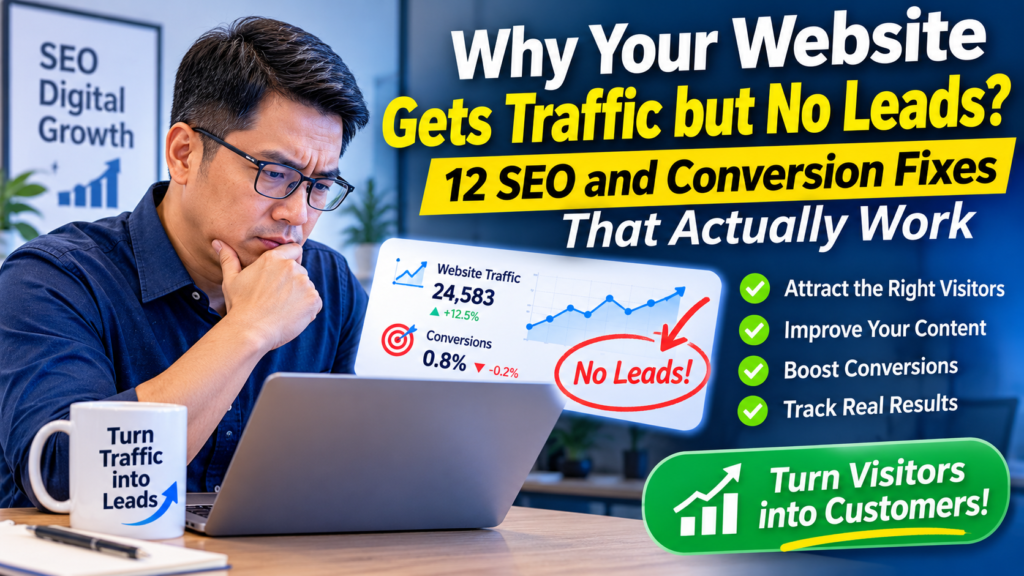
Getting visitors to your website is a good start. But what happens when hundreds or even thousands of people visit your website without calling, submitting an enquiry, requesting a quotation, or making a purchase?
This is one of the most common problems I encounter when evaluating business websites.
A website can rank on Google, attract organic traffic, and receive impressions in search results but still struggle to generate meaningful business opportunities.
The problem isn’t always SEO. Sometimes, the website attracts the wrong audience. In other cases, visitors cannot find the information they need, the website lacks credibility, or there is no clear reason to take action.
After more than 15 years working in SEO, web development, and digital marketing, I’ve learned that successful websites need more than rankings and traffic. They need a strategy that connects search visibility with user experience and conversion.
In this guide, I’ll explain 12 practical ways to turn your website traffic into qualified leads and potential customers.
Quick Answer: Why Does Your Website Get Traffic but No Leads?
Your website may receive traffic without generating leads because:
- You’re attracting visitors who aren’t interested in your services.
- Your pages don’t match the search intent of your audience.
- Your website has unclear calls to action.
- Your content doesn’t communicate your value.
- Your website lacks trust signals and credibility.
- Your contact forms are complicated or difficult to find.
- Your mobile experience is poor.
- Your website loads slowly.
- Your landing pages aren’t optimized for conversions.
- Your SEO strategy focuses on rankings instead of business results.
- You’re not tracking important conversion events.
- You’re not following up with potential customers.
The solution is to evaluate your entire customer journey, from the first Google search to the moment someone contacts your business.
1. Attract the Right Website Visitors
Not all website traffic is valuable.
A website receiving 10,000 monthly visitors isn’t necessarily performing better than a website receiving 1,000 highly targeted visitors.
For example, imagine you operate a plumbing business in Manila.
Ranking for a broad informational keyword such as “how plumbing works” might bring visitors, but many of them are simply researching.
Meanwhile, ranking for “emergency plumber in Manila” attracts people who may actually need your services.
These searches have different intentions.
What you should do:
- Identify keywords related to your products and services.
- Prioritize commercial and transactional search intent.
- Create dedicated landing pages for your core services.
- Target relevant locations if you serve specific geographical areas.
- Review Google Search Console to identify which search queries bring visitors to your website.
The objective isn’t simply to increase organic traffic. It’s to attract people who are more likely to become customers.
2. Match Your Content With Search Intent
Search intent refers to the reason behind a person’s search.
Someone searching for “what is SEO” is probably looking for information.
Someone searching for “SEO consultant Philippines” may already be considering hiring an SEO professional.
If your landing page doesn’t satisfy the searcher’s expectations, visitors may leave without taking action.
For example, a service page targeting “WordPress web development services” should clearly explain:
- What WordPress development services you offer.
- Who your services are designed for.
- What problems you can solve.
- Your development process.
- Relevant projects or portfolio examples.
- How potential clients can get started.
Avoid creating pages that simply repeat keywords without providing useful information.
A strong landing page answers the visitor’s questions and helps them make an informed decision.
3. Make Your Call to Action Impossible to Miss
One of the biggest conversion problems is a website that doesn’t tell visitors what to do next.
Your visitors shouldn’t have to search through multiple pages just to find your contact information.
Every important landing page should have a clear call to action (CTA).
Examples include:
- Request a Free SEO Audit
- Get a Website Development Quote
- Schedule a Consultation
- Request a Free Assessment
- Contact Our Team
- Book an Appointment
Place your CTA strategically:
- Near the top of the page.
- After explaining your services.
- After presenting testimonials or case studies.
- At the end of the page.
Make sure your CTA buttons are easy to recognize, especially on mobile devices.
A well-designed CTA gives visitors a clear next step without making the experience feel overwhelming.
4. Improve Your Website Loading Speed
Website speed affects user experience and can influence search performance.
Visitors expect websites to load quickly. If your pages take too long to become usable, potential customers may leave before seeing your services.
Common performance problems include:
- Oversized images.
- Unnecessary WordPress plugins.
- Poor hosting performance.
- Unoptimized JavaScript and CSS.
- Excessive third-party scripts.
- Poor caching configuration.
- Unoptimized fonts and media files.
My recommendation: Use Google PageSpeed Insights to evaluate your website’s performance on mobile and desktop.
Pay particular attention to Core Web Vitals:
- Largest Contentful Paint (LCP): measures loading performance.
- Interaction to Next Paint (INP): measures responsiveness.
- Cumulative Layout Shift (CLS): measures visual stability.
Improving website performance is not just about achieving a higher score. It’s about making your website easier and more comfortable to use.
5. Build Trust Through Testimonials, Reviews, and Case Studies
People rarely contact a business they don’t trust.
Before making an enquiry, visitors often want to know whether your business has the experience and capability to deliver what it promises.
Your website should demonstrate credibility through real evidence.
Consider adding:
- Verified customer testimonials.
- Google Business Profile reviews.
- Project portfolios.
- Before-and-after examples.
- Detailed case studies.
- Professional certifications and relevant credentials.
- Business contact information.
- Clear company information and an About page.
For service businesses, case studies are particularly valuable.
Instead of simply saying that you provide SEO services, explain how you approached a real website’s technical issues, improved its structure, optimized its content, or strengthened its local visibility.
Demonstrating your work is more convincing than making unsupported marketing claims.
6. Create Dedicated Landing Pages for Your Services
A common mistake is placing every service on one general page.
For example, a digital marketing agency might offer:
- Search Engine Optimization.
- Local SEO.
- Website Design.
- WordPress Development.
- Technical SEO Audits.
- Social Media Marketing.
If all these services are presented on one page without sufficient detail, visitors may struggle to understand which service addresses their particular needs.
Instead, create dedicated landing pages.
Each page should have:
- A specific target keyword.
- A clear service description.
- The customer’s problem and your solution.
- Benefits and deliverables.
- Relevant examples.
- Frequently asked questions.
- A clear conversion opportunity.
This structure also helps search engines understand the purpose of each page.
7. Optimize Your Website for Mobile Users
Many potential customers discover businesses using their smartphones.
If your website looks great on desktop but is difficult to navigate on mobile, you could be losing enquiries.
Check the following:
- Is your navigation easy to use?
- Are your contact buttons visible?
- Can visitors easily tap your phone number?
- Are your forms simple to complete?
- Is the text readable without zooming?
- Do images and sections fit smaller screens?
- Are important elements accessible without excessive scrolling?
For local service businesses, consider adding click-to-call buttons and easy-to-access messaging options.
Your mobile website should make contacting your business effortless.
8. Simplify Your Contact Forms
Long and complicated forms can discourage potential customers.
Imagine a visitor who wants to request a quotation but is required to complete 15 different fields.
They may decide it’s easier to contact another business.
Keep your forms simple.
For most service businesses, start with:
- Name.
- Email address.
- Phone number (when necessary).
- Service required.
- Brief message.
Only request information that is genuinely needed at the initial enquiry stage.
Also, make sure your forms work correctly. Test submissions, confirmation messages, email notifications, and spam protection.
A contact form that looks good but fails to deliver enquiries is a serious business problem.
9. Strengthen Your Local SEO Strategy
If your business serves customers in specific cities or service areas, local SEO can help you attract people searching for nearby services.
Start by optimizing your Google Business Profile.
Make sure your business information is accurate and consistent.
Focus on:
- Correct business name, address, and phone number.
- Appropriate primary and secondary categories.
- Accurate business hours.
- Complete service descriptions.
- High-quality business photos.
- Genuine customer reviews.
- Regular updates and posts.
- Relevant local landing pages.
You should also build relevant local citations and maintain consistent business information across trusted directories.
For businesses serving multiple locations, create genuinely useful location pages instead of publishing dozens of nearly identical pages.
Local SEO should help customers discover your business and make contacting you easier.
10. Make Your Website Content More Helpful and Persuasive
Your website content should do more than describe your services.
It should explain why customers should choose your business.
For example, instead of writing:
“We provide professional SEO services.”
Consider explaining:
“We help businesses improve their visibility on Google through technical SEO, keyword research, content optimization, and local search strategies designed to attract relevant customers.”
The second statement communicates what you do and how you help.
Improve your content by:
- Addressing customer pain points.
- Explaining your services in simple language.
- Answering common questions.
- Providing practical examples.
- Using descriptive headings.
- Including relevant images.
- Linking to supporting articles and service pages.
Your content should demonstrate expertise while helping potential customers understand the value of working with you.
11. Track Conversions Using Google Analytics 4 and Google Tag Manager
One of the biggest mistakes in digital marketing is measuring website performance using traffic alone.
You need to understand what visitors actually do.
I recommend configuring Google Analytics 4 (GA4) and Google Tag Manager (GTM) to track meaningful conversion actions.
Depending on your business, these may include:
| Conversion action | What it measures |
|---|---|
| Contact form submission | Completed enquiries |
| Phone number click | Visitors attempting to call |
| Email link click | Visitors interested in contacting you |
| Reservation button click | Visitors proceeding to booking |
| WhatsApp or Messenger click | Visitors starting a conversation |
| Purchase | Completed online transactions |
You can also connect Google Search Console to understand which organic search queries attract visitors.
For businesses with online reservations, track clicks on reservation links and, where possible, completed bookings.
This allows you to understand whether your SEO efforts are generating meaningful customer actions rather than simply increasing page views.
12. Optimize Your Website for Google and AI Search
Search behavior is evolving.
People still use traditional search engines, but they are increasingly encountering AI-powered search experiences such as Google AI Overviews, ChatGPT, and Gemini.
Businesses should therefore build websites that are useful, understandable, and supported by credible information.
Some practical recommendations include:
- Publish original, experience-driven content.
- Organize pages using clear headings.
- Provide direct answers to important questions.
- Implement relevant structured data.
- Maintain accurate business information.
- Build a strong About page and author profile.
- Publish genuine case studies and supporting evidence.
- Earn relevant backlinks and brand mentions.
- Keep important service information consistent across your digital presence.
AI search optimization is not about inserting special keywords or guaranteeing that an AI platform will recommend your business.
It’s about building a credible online presence that search engines and AI systems can understand and potentially reference.
How to Measure Whether Your Website Is Actually Generating Leads
Once you’ve implemented improvements, measure the results.
Don’t rely exclusively on website traffic or keyword rankings.
Use a combination of SEO, analytics, and business performance metrics.
| Metric | Why it matters |
|---|---|
| Organic clicks | Measures visitors coming from organic search |
| Organic impressions | Shows how often your pages appear in Google |
| Click-through rate | Measures how often people click your search listings |
| Engaged sessions | Helps evaluate visitor engagement |
| Conversion events | Measures meaningful website actions |
| Qualified leads | Measures potential customers |
| Conversion rate | Measures the percentage of visitors who convert |
| Cost per lead | Helps evaluate marketing efficiency |
For example, if your website receives 2,000 organic visitors and generates 40 enquiries, your website conversion rate is:
40 ÷ 2,000 × 100 = 2%
However, not every enquiry becomes a customer.
You should also monitor lead quality, sales opportunities, and actual revenue.
The ultimate goal is to generate more qualified leads and business opportunities.
Final Thoughts: Traffic Is Only the Beginning
Getting your website to rank on Google is important, but rankings alone don’t guarantee business growth.
Your website needs to attract the right audience, provide useful information, establish credibility, and make it easy for visitors to take action.
From technical SEO and website speed to content optimization, user experience, and conversion tracking, every part of your website should work toward a common objective.
My approach to SEO has always been to look beyond rankings. I want to understand how a website contributes to the business, where potential customers encounter problems, and what improvements can make a measurable difference.
If your website is receiving traffic but not generating enough enquiries, it may be time to review your SEO strategy and website experience together.
Need help improving your website’s SEO and lead generation?
I’m Alvin John Ferias, an SEO Specialist, Web Developer, and Digital Marketing Consultant based in the Philippines. With more than 15 years of experience, I help businesses improve their search visibility, strengthen their websites, and build strategies that support long-term digital growth.
Visit my website or contact me for a free SEO audit.
Frequently Asked Questions
1. Why is my website getting traffic but no enquiries?
Your website may be attracting visitors who aren’t ready to purchase, targeting irrelevant keywords, or providing a poor user experience. Unclear calls to action, weak trust signals, and complicated contact forms can also prevent visitors from becoming leads.
2. How can I turn website traffic into leads?
Focus on attracting relevant visitors, creating targeted landing pages, improving your content, adding clear calls to action, simplifying contact forms, and tracking conversion events through Google Analytics 4.
3. Does SEO guarantee more sales?
No. SEO can improve search visibility and attract relevant visitors, but sales also depend on your pricing, service quality, website experience, reputation, competition, and sales process.
4. What is a good website conversion rate?
There is no universal conversion rate that applies to every industry. Results depend on the website’s purpose, traffic source, audience, offer, and definition of conversion. Establish a baseline and work toward improving it using reliable analytics data.
5. Should I prioritize SEO or website design?
Both are important. SEO helps potential customers discover your website, while good website design and user experience help visitors understand your business and take action. They should be developed together.
6. How do I know if my SEO campaign is generating leads?
Use Google Analytics 4, Google Search Console, and Google Tag Manager to measure organic traffic, enquiry submissions, phone clicks, booking clicks, and other important conversion events. Compare these metrics with actual qualified leads and sales.
AIO Quick Answer: How Do You Turn Website Traffic Into Leads?
Turning website traffic into leads requires more than improving search rankings. Businesses need to attract visitors with relevant search intent, provide helpful content, establish trust, and create clear conversion opportunities.
The most effective approach combines SEO, conversion rate optimization (CRO), website performance, and conversion tracking. By improving landing pages, simplifying contact forms, adding clear calls to action, and measuring user actions through Google Analytics 4, businesses can identify opportunities to turn organic visitors into qualified enquiries.
Key Takeaways
- More website traffic does not automatically mean more customers.
- Search intent determines the quality of organic visitors.
- Dedicated service pages can improve relevance and conversions.
- Trust signals help visitors make purchasing decisions.
- Mobile optimization and website speed improve user experience.
- Conversion tracking helps measure actual SEO performance.
- AI search visibility should complement traditional SEO.
AIO: Important SEO Definitions
What is website conversion optimization?
Website conversion optimization is the process of improving a website to increase the percentage of visitors who complete valuable actions, such as submitting a form, calling a business, or making a purchase.
What is SEO lead generation?
SEO lead generation uses organic search visibility and optimized website content to attract potential customers and encourage them to enquire about products or services.
What is the difference between website traffic and qualified leads?
Website traffic measures visitors to a website, while qualified leads are potential customers who demonstrate genuine interest in a business’s products or services.
How does AI search affect SEO lead generation?
AI-powered search experiences provide summarized answers and links to relevant websites. Businesses should maintain strong technical SEO, publish original and helpful information, and establish credible online identities to improve their eligibility for visibility in these experiences.