By Alvin John Ferias, AI SEO Specialist, Philippines · Last updated: October 26, 2026 · 9 min read
Quick Answer: What Is AI SEO and How Does It Help Philippine Businesses?
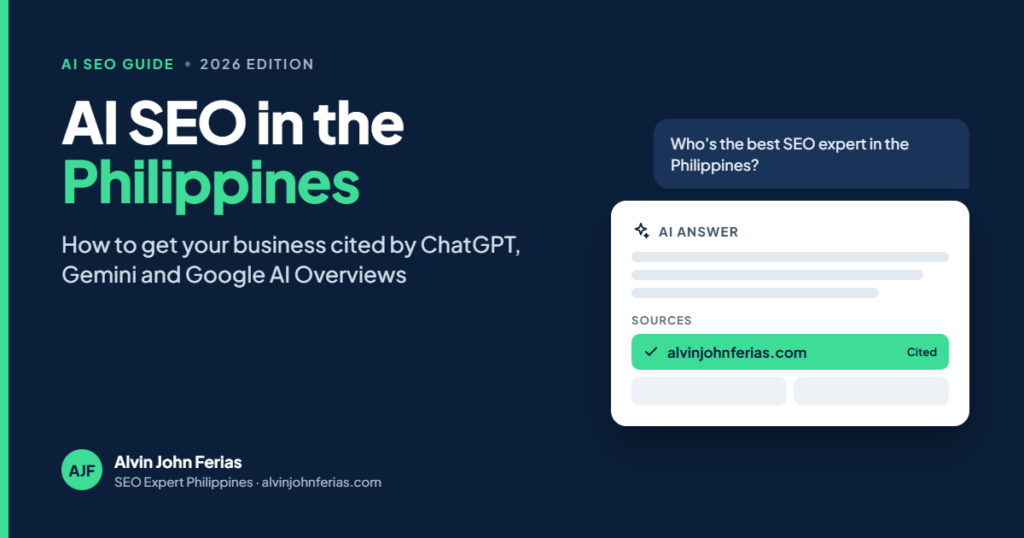
AI SEO (also called GEO, or Generative Engine Optimization) is the work of making your business the source that AI tools quote when people ask questions. Those tools include ChatGPT, Google Gemini, Perplexity, Microsoft Copilot and Google AI Overviews. To get cited, your website needs clear answers, strong expertise signals, clean structured data, and mentions of your brand across trusted Philippine sites. Good traditional SEO is still the foundation, because AI tools pull heavily from pages that already rank and are easy to crawl.
Ask ChatGPT “Who is the best dental clinic in Quezon City?” or “Saan makakabili ng affordable solar panels sa Cavite?” and you get a short answer with only a few businesses named. If your business isn’t one of them, that customer may never see your website at all.
That is the shift happening in search right now. Filipinos still use Google every day, but more of them now read an AI summary at the top of the page, or skip Google and ask an AI assistant directly. Fewer people scroll through ten blue links.
I’ve done SEO for more than 15 years, and this is the biggest change I’ve seen in how customers find businesses. In this guide, I’ll explain what AI SEO is, how AI tools decide who to mention, and the exact steps I use to help Philippine businesses show up in AI answers.
AI SEO, GEO and AIO: What the Terms Mean
You’ll see several names for the same idea. They overlap a lot, so don’t worry about the labels:
- AI SEO – the umbrella term for optimizing your brand and content for AI-powered search.
- GEO (Generative Engine Optimization) – getting cited in answers from generative AI tools like ChatGPT, Gemini and Perplexity.
- AIO / AEO (AI or Answer Engine Optimization) – structuring content so AI systems and Google features can lift a direct answer from it.
How AI SEO differs from traditional SEO
| Traditional SEO | AI SEO / GEO | |
|---|---|---|
| Goal | Rank a page on Google | Get your brand named or cited inside an AI answer |
| What wins | Keywords, backlinks, technical health | Clear answers, expertise, brand mentions, structured data |
| Unit of success | A position (#1, #3, #8) | A mention or a citation link |
| How users act | Click a result, then read | Read the answer, then maybe click |
| Measurement | Rankings, clicks, traffic | Mentions in AI tools, referral traffic from AI, branded searches |
The important point: AI SEO does not replace SEO. Google AI Overviews and AI chat tools with web search lean on pages that are already indexed and trusted. A site with weak SEO rarely gets cited. Think of AI SEO as the next layer on top of a solid SEO foundation.
How AI Search Tools Decide Which Businesses to Mention
No AI company publishes an exact formula. But from testing client sites and my own, a few signals keep showing up in the businesses that get cited:
- The page answers the question directly. AI tools prefer content where the answer sits in the first one or two sentences under a clear heading. Long, vague introductions get skipped.
- The brand is mentioned in many trusted places. AI models learn who is “known” for a topic from directories, news sites, reviews, forums and social profiles, not just your own website. Consistent mentions build that association.
- The content shows real expertise. Named authors, credentials, case studies, original data and local experience make content more citable than generic articles anyone could write.
- The page is technically easy to read. Fast loading, clean HTML, crawlable text (not text hidden in images), and schema markup help both Google and AI crawlers understand the page.
- The information is consistent. Your business name, address, phone, services and prices should match across your website, Google Business Profile, Facebook page and directories. Conflicting details lower trust.
- The content is fresh. For topics like pricing, laws or “best of” lists, AI tools favor recently updated pages. A visible “Last updated” date helps.
8 Steps to Get Your Philippine Business Cited by AI
This is the process I follow for clients. You can do many of these steps yourself.
Step 1: Check where you stand today
Before changing anything, ask the AI tools the questions your customers ask. Try ChatGPT, Gemini, Perplexity and Copilot, and search Google to see if an AI Overview appears.
- Use real customer phrasing, including Taglish: “best SEO specialist in the Philippines”, “magkano ang aircon cleaning sa Makati”.
- Write down which competitors get named and which websites get cited as sources.
- Repeat the same prompts every month so you can track progress.
Step 2: Fix your SEO foundation
AI tools that search the web rely on pages that are indexed and trusted. Make sure Google can crawl and index your important pages, your site loads fast on mobile data, and each service has its own page. If you’re not sure where your site stands, start with a proper SEO audit.
Also check your robots.txt file. Some security plugins and hosting setups block AI crawlers by default. If you want to be cited, don’t block the crawlers used for AI search.
Step 3: Research the questions, not just the keywords
People talk to AI tools in full sentences. Build a list of real questions from your customers, Google’s “People also ask” box, Facebook comments and your Messenger inbox. My guide to local keyword research shows how to find these for Philippine searches.
Step 4: Write answer-first content
Structure each page so an AI tool can lift a clean answer:
- Use questions as H2 or H3 headings.
- Answer in the first one or two sentences, then explain.
- Add a short “Quick Answer” box at the top of long posts.
- Use tables for prices, comparisons and specs, and numbered lists for processes.
- Include specifics: prices in pesos, locations, timelines, and real numbers.
Step 5: Prove your expertise (E-E-A-T)
AI tools and Google both look for signs of a real expert behind the content. Add an author name and short bio to every post, link to an About page with your credentials, and share real case studies with results. First-hand experience, like local projects, photos, and lessons learned, is hard for competitors to copy.
Step 6: Add structured data
Schema markup tells machines exactly what your page is about. The most useful types for Philippine businesses are:
- LocalBusiness or ProfessionalService – name, address, phone, hours, service area
- Organization and Person – who runs the business, with links to social profiles
- FAQPage – your question-and-answer sections
- Article – blog posts with author and dates
- Service and Review – what you offer and what customers say
On WordPress, Rank Math or Yoast handles most of this without code.
Step 7: Build brand mentions beyond your website
This is the step most businesses skip. AI tools learn about your brand from the wider web, so you need to be talked about in trusted places:
- Fully complete and update your Google Business Profile, and collect reviews.
- List your business in reputable Philippine directories and industry associations.
- Get featured in local news sites, podcasts, school or LGU events, and partner websites.
- Answer questions in Facebook groups, Reddit and Quora where your customers ask.
- Keep your name, address and phone the same everywhere.
Step 8: Keep content fresh and connected
Update key pages at least every few months and show the “Last updated” date. Link related posts and service pages together so both readers and crawlers can follow the topic. For example, this guide connects to my AI SEO service and local SEO guide for Manila.
Common AI SEO Mistakes I See in the Philippines
- Mass-producing AI-written articles. Generic content with no experience or local detail rarely gets cited. It adds nothing an AI tool doesn’t already know.
- Hiding key information in images or PDFs. Prices, service lists and addresses inside Canva graphics can be hard for crawlers to read. Put them in real text too.
- Blocking AI crawlers by accident. A security plugin or CDN setting can block the bots that power AI search. Check your settings.
- Inconsistent business details. An old phone number on Facebook and a new one on your site confuses both Google and AI tools.
- Ignoring off-site mentions. A perfect website that no one else talks about has weak authority.
- Chasing tricks. Hidden text, keyword stuffing, or fake reviews can damage trust with Google and AI systems. Stick to useful, honest content.
How to Measure Your AI Visibility
AI SEO is harder to measure than rankings, but you can still track real progress:
| What to track | How to check it |
|---|---|
| Brand mentions in AI answers | Run the same set of customer prompts monthly in ChatGPT, Gemini, Perplexity and Copilot; log who gets named |
| Citations in Google AI Overviews | Search your target questions and note whether your pages appear as sources |
| Referral traffic from AI tools | In Google Analytics 4, check referrals from domains like chatgpt.com, perplexity.ai, gemini.google.com and copilot.microsoft.com |
| Branded search growth | In Google Search Console, watch impressions for searches that include your business name |
| Leads that mention AI | Ask new clients “How did you find us?” and add “ChatGPT / AI tool” as an option on your contact form |
Expect gradual change. Brand mentions and authority build over months, not days, the same way traditional SEO does.
Frequently Asked Questions About AI SEO in the Philippines
Is AI SEO different from regular SEO?
Yes, but they work together. Regular SEO helps your pages rank on Google. AI SEO helps your brand get named and cited inside AI answers. Most AI citations come from sites that already have strong SEO.
Will AI search kill SEO?
No. AI tools still need websites as sources, and Google remains a major source of traffic for Philippine businesses. What changes is how you win: clear answers, real expertise and brand authority matter more than ever.
How long does AI SEO take to show results?
On-page fixes like answer-first content and schema can be picked up within weeks once pages are recrawled. Building brand authority across the web usually takes three to six months or more, depending on your industry and competition.
Can small businesses in the Philippines benefit from AI SEO?
Yes. Local questions like “best bakery in Calapan” or “plumber near BGC” often have few strong sources. A small business with a complete Google Business Profile, good reviews and clear service pages can stand out.
Do I need to pay for ChatGPT or other AI tools to appear in them?
No. You can’t pay to be cited in organic AI answers. Citations are earned through useful content, trust signals and brand mentions.
Should I block AI crawlers from my website?
If you want your business to appear in AI answers, generally no. Blocking the crawlers used for AI search can stop your pages from being cited. Some publishers block training crawlers for content reasons, so decide based on your goals.
Get Your Business Into AI Answers
AI search is changing how Filipinos find businesses, but the winners follow the same basics: a technically sound website, content that answers real questions, proof of expertise, and a brand people talk about. Start with Step 1 this week. Ask the AI tools about your services and see who they recommend.
If you want help, I offer AI SEO services for Philippine businesses, from AI visibility audits to content, schema and brand-mention campaigns. Contact me or message me on Messenger to talk about getting your business cited by ChatGPT, Gemini and Google AI Overviews.