AI SEO: What It Is and How to Become an AI SEO Expert in 2026
Last updated:
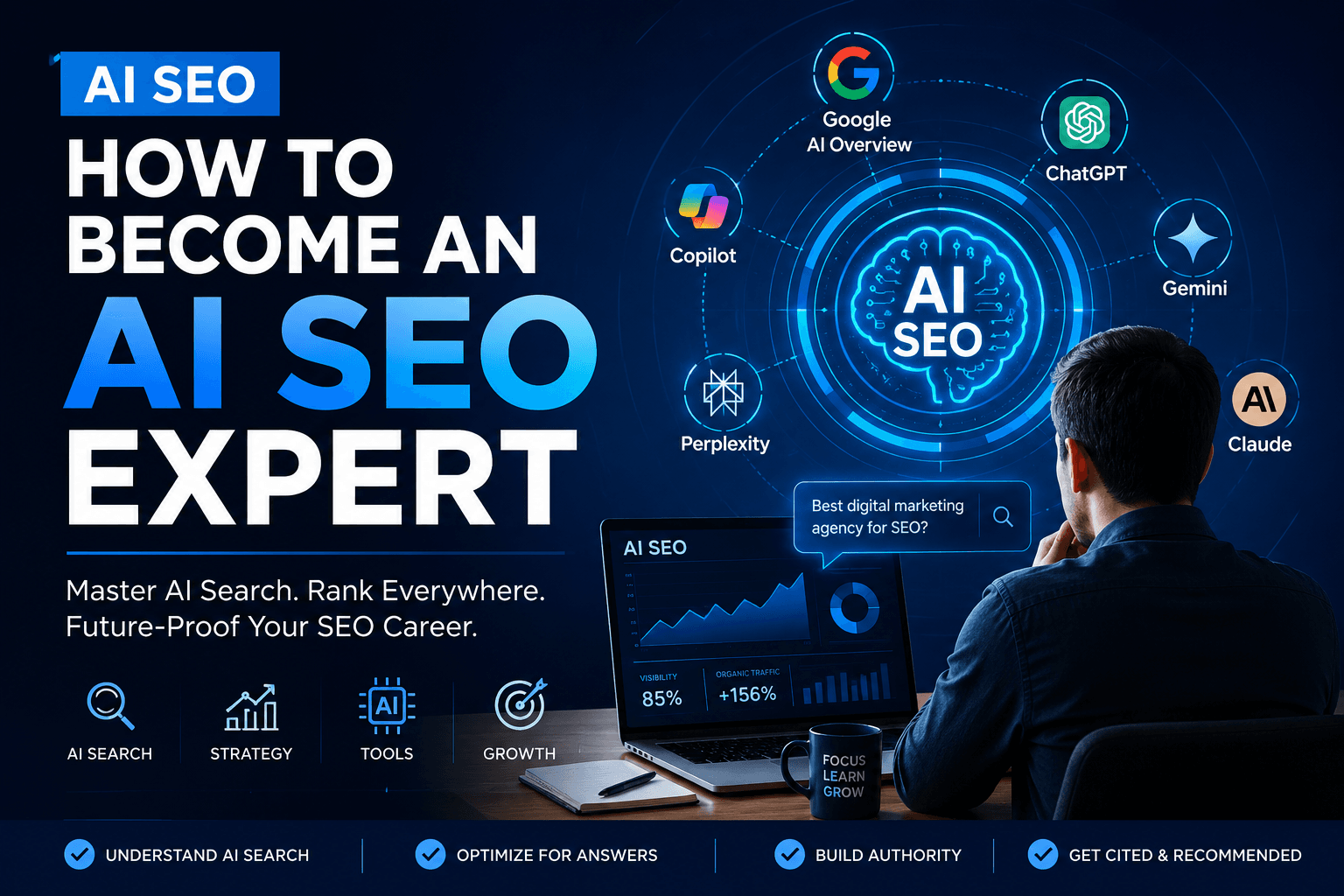
Search is going through its biggest shift since Google launched. People aren’t just typing keywords into a search box anymore — they’re asking ChatGPT, Gemini, Perplexity, and Copilot full questions and expecting a direct answer, often with zero clicks to a website. If your content isn’t built for that world, you’re invisible in it.
This is where AI SEO — also called Generative Engine Optimization (GEO) or Answer Engine Optimization (AEO) — comes in. Below is a practical breakdown of what it actually means, why it matters now, and the skill path to becoming genuinely good at it. If you’re still working on the fundamentals, start with our complete guide to on-page SEO before layering GEO on top.
What Is AI SEO / GEO?
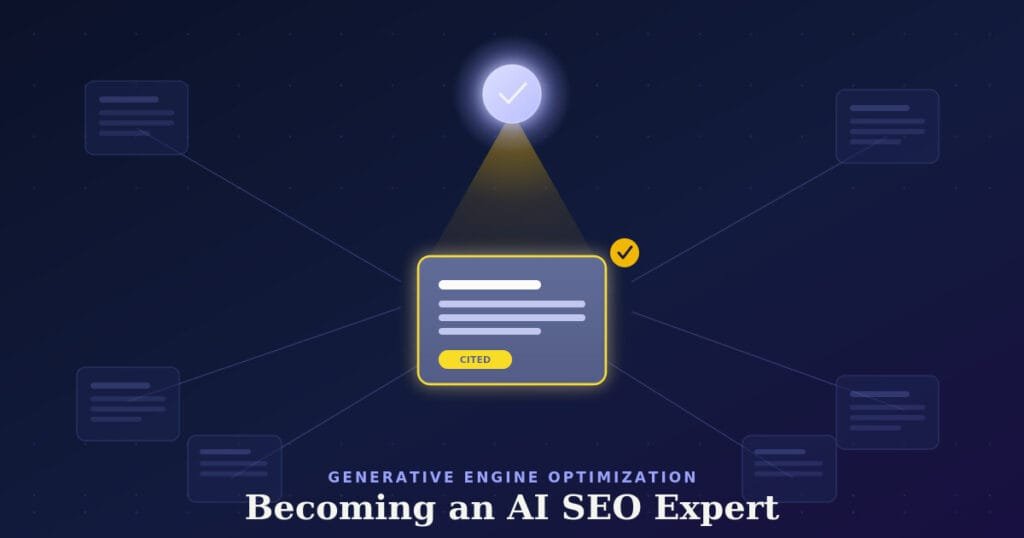
Generative engine optimization is the practice of structuring content and digital presence so that AI-powered search platforms — including ChatGPT, Google AI Overviews, Perplexity, Claude, and Copilot — can retrieve, cite, and recommend a brand when answering user questions. Traditional SEO fought for one of ten blue links. GEO is about earning a place among the two to seven domains large language models typically cite in a single response — a much smaller, more competitive playing field, but one with a bigger reward: when an AI engine names a brand in its answer, it functions as an implicit endorsement no ordinary organic listing could deliver.
The underlying logic is different too. LLMs understand the world through entities and the relationships between them rather than through keywords, which makes an entity-first approach to content essential. AI models also favor sources with in-depth knowledge that cover all the sub-topics of a niche, rewarding real topical authority over shallow, generic content. This is closely related to the idea of building topical authority through content clusters, which remains just as important for GEO as it is for classic SEO.
Why 2026 Is the Turning Point
A few forces are converging right now:
- Platform loyalty is forming. As people settle into the AI engines they prefer, ChatGPT may become “the Google” of generative search for many users — but that doesn’t mean other engines can be ignored, since the right strategy is to focus on wherever your specific audience actually spends time.
- Ranking is being replaced by visibility. Generative engines don’t operate on a position-based ranking system, so the game has shifted toward brand visibility and mention frequency instead of a numbered slot.
- RAG is the new crawler. Retrieval-Augmented Generation, where AI pulls real-time data from external sources, is one of the most important technologies shaping SEO in 2026, and making content genuinely “retrievable” now depends on original research, expert opinion, and well-structured information.
- SEO has become a team sport. Succeeding at search in 2026 requires integrating editorial, IT, UX, PR, and product management functions, not just a content team working alone.
The Core Skills of an AI SEO Expert
1. Entity and Topical Authority Building
Stop thinking in keywords, start thinking in entities — people, brands, products, concepts — and how they connect. Build content clusters that exhaustively cover a subject rather than one-off articles chasing search volume.
2. Structured, Machine-Readable Content
AI systems parse and extract far better from content that’s cleanly organized: clear headers, direct answers near the top, well-tagged schema markup, FAQ sections, and tables. Write the way you’d want to be quoted. See our guide to schema markup for WordPress for implementation details.
3. Original Data and Expertise
AI engines can detect redundant or repeated content, which makes original research and genuinely fresh insight essential to influencing what gets generated and cited. Proprietary surveys, first-hand case studies, and expert commentary are now competitive advantages, not nice-to-haves.
4. Digital PR and Off-Site Authority
Blending creative content with structured technical signals increases the odds of being cited by both traditional search engines and AI models, which puts a real premium on media relations, digital PR, and thought leadership. Getting mentioned and linked from reputable third-party sources feeds directly into how trustworthy an LLM perceives your brand to be. Our digital PR and link-building playbook covers this in more depth.
5. AI Search Performance Tracking
As GEO becomes a more significant channel for leads and traffic, tracking visibility and ROI across generative engines with dedicated tools has become a real business need. Learn to monitor brand mentions and citation frequency across AI platforms, not just rankings in a search results page.
6. Personalization-Aware Content
Effective personalization means tailoring information to a user’s skill level, funnel stage, and specific sub-interests — meeting people where they actually are rather than writing one generic version for everyone.
7. Multimodal Thinking
AI systems are increasingly processing text, images, video, and audio together, which opens new optimization requirements across every media format a brand publishes, not just written pages.
A Practical Roadmap to Get There
- Audit your current visibility. Ask ChatGPT, Perplexity, and Gemini questions your target customers would ask. Are you mentioned? Are competitors?
- Master the fundamentals of traditional SEO first. GEO builds on top of technical SEO, content strategy, and link-building — it doesn’t replace the need to understand them. Our technical SEO checklist is a solid starting point.
- Learn schema markup and structured data. This is the technical bridge between your content and how AI systems parse it.
- Study how RAG and LLMs retrieve information. Understanding embeddings, chunking, and retrieval at a conceptual level will make your content decisions sharper.
- Build a portfolio of citation wins. Track and document cases where your content got cited or mentioned by an AI engine — this becomes your proof of expertise.
- Stay current, deliberately. A working GEO strategy means assessing where you stand, optimizing your technical and content foundation for AI retrieval, measuring performance across the platforms that matter, and then iterating relentlessly — this is not a one-time project.
The Bottom Line
The most significant shift in SEO right now is the move toward content that AI models treat as a primary, trustworthy source rather than just one more indexed page. Becoming an AI SEO expert isn’t about learning a new set of tricks — it’s about understanding how language models actually retrieve, evaluate, and cite information, then building content and authority systems around that reality. The marketers and businesses who treat this seriously now, while most of the market is still catching up, are the ones who’ll own the citations in 2027 and beyond.
Ready to go deeper? Check out our related guide on AI-driven content strategy to see how GEO fits into a broader marketing plan.
Frequently Asked Questions
What is AI SEO?
AI SEO, also called Generative Engine Optimization (GEO), is the practice of structuring content so AI-powered platforms like ChatGPT, Google AI Overviews, Perplexity, and Copilot can retrieve, cite, and recommend it when answering user questions.
How is GEO different from traditional SEO?
Traditional SEO competes for a ranked position among ten search results. GEO competes to be one of a handful of sources an AI model actually cites or mentions in a generated answer, and success is measured by visibility and citation frequency rather than rank position.
What skills does an AI SEO expert need?
Core skills include entity and topical authority building, structured and machine-readable content, original research and data, digital PR, AI search performance tracking, and an understanding of how retrieval-augmented generation (RAG) systems pull and use information.
Do I need to learn traditional SEO before GEO?
Yes. GEO builds on top of technical SEO, content strategy, and link-building fundamentals rather than replacing them, so a solid base in traditional SEO makes GEO strategy far more effective.