
By Alvin John Ferias, SEO Specialist and DICT SPARK Trainer, Philippines · Published: November 19, 2026 · 12 min read
How to become an SEO expert is one of the questions I hear most from students, virtual assistants and career shifters at my DICT SPARK trainings. The honest answer: you don’t need a degree or expensive certificates. You need solid fundamentals, real practice on real websites, proof of results and the patience to keep learning as search changes.
I started as a programmer, moved into web development, then into SEO. I founded webdeveloper.com.ph in 2008, and over the past 15+ years I’ve worked with Philippine, Australian, US and UK clients and trained new freelancers through DICT programs since 2018. This guide is the roadmap I wish someone had handed me at the start, updated for 2026, when SEO now includes Google, Google Maps and AI tools like ChatGPT and Gemini.
Quick Answer: How Do You Become an SEO Expert?
To become an SEO expert in the Philippines, follow these steps:
- Learn the fundamentals: how search engines crawl, index and rank pages.
- Master the core skills: keyword research, on-page SEO, technical SEO, local SEO, content and link building.
- Add AI search skills: AI Optimization (AIO) and Generative Engine Optimization (GEO) for ChatGPT, Gemini and Google AI Overviews.
- Practice on a real website: build your own site or help a small business for free.
- Build a portfolio: document results with Search Console screenshots and short case studies.
- Land your first clients: start with local businesses, job boards or agency roles.
- Keep learning and specialize: pick a niche, such as technical, local, ecommerce or AI SEO.
Most people can learn the basics in a few weeks and land their first paid work within a few months. Becoming a true expert, someone who can diagnose and fix almost any SEO problem, usually takes two to five years of hands-on work.
What Does an SEO Expert Actually Do?
An SEO expert helps websites get more qualified visitors from search engines and, increasingly, from AI answers. On a typical week, that work includes:
- Checking Google Search Console and Google Analytics 4 for drops, wins and new opportunities.
- Researching keywords and planning which pages should target them.
- Fixing technical problems, such as indexing errors, slow pages or broken redirects.
- Rewriting titles, headings and content so pages match what searchers want.
- Managing Google Business Profiles for local clients.
- Earning links and brand mentions from relevant websites.
- Testing how AI tools describe a client and which sources they cite.
- Reporting results to clients in plain language and planning next steps.
The job is part analyst, part writer, part technician and part teacher. You don’t need to be the best at all four on day one, but an expert can do all of them well enough to lead a project.
The SEO Career Path in the Philippines
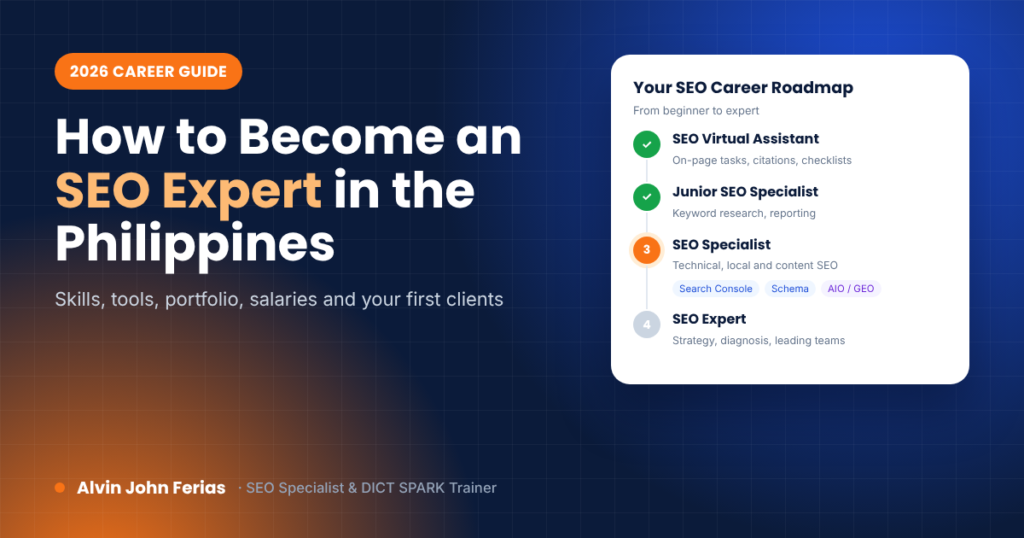
Most Filipino SEO experts didn’t start as experts. They moved up through a few typical stages:
| Stage | Typical role | What you do | How long people usually stay |
|---|---|---|---|
| 1. Beginner | SEO virtual assistant, link builder, content uploader | Follow checklists, do on-page tasks, build citations | 3 to 12 months |
| 2. Junior | Junior SEO specialist | Keyword research, on-page optimization, reporting | 1 to 2 years |
| 3. Mid-level | SEO specialist | Run campaigns for several clients, fix technical issues | 2 to 4 years |
| 4. Senior / expert | Senior SEO, SEO consultant, SEO lead | Diagnose complex problems, set strategy, lead teams | Ongoing |
| 5. Business owner | Freelance SEO expert or agency owner | Win and manage clients, hire and train others | Ongoing |
The titles are less important than the skills behind them. Job ads in 2026 increasingly ask for AI search skills too. On SEO job boards, you’ll now see listings titled “SEO / GEO / AEO Specialist” and “SEO/GEO/AI Search Specialist” in Metro Manila. That’s a clear sign of where the career is heading.
If you’re still deciding between this and web development, read my guide on how to become a web developer. Many of the best technical SEO experts have both skill sets.
The Skills Roadmap: What to Learn and in What Order
If you want to know how to become an SEO expert efficiently, learn the skills in this order. Each one builds on the last.
1. How Search Engines Work
Understand crawling, indexing and ranking before anything else. Read Google’s free SEO Starter Guide and set up Google Search Console on any website you can access. Most beginner mistakes come from skipping this step.
2. Keyword Research and Search Intent
Learn to find what people actually type, how many people search for it, and what they want when they do. Practice grouping keywords by intent: informational, commercial, transactional and local. For Philippine clients, learn to spot Taglish and price-based searches. My local keyword research guide is a good starting point.
3. On-Page and Content SEO
Titles, meta descriptions, headings, internal links, image alt text and content quality. Learn to write content that answers a question better than the pages already ranking, and to show real experience, which Google calls E-E-A-T.
4. Technical SEO
This is where many beginners stop, and where experts stand out. Learn robots.txt, XML sitemaps, canonical tags, redirects, Core Web Vitals, schema markup and how WordPress works under the hood. My technical SEO checklist covers what to learn.
5. Local SEO
Most Philippine businesses serve a city or province, so local SEO is often your first paid skill. Learn Google Business Profile optimization, reviews, citations and location pages.
6. Link Building and Digital PR
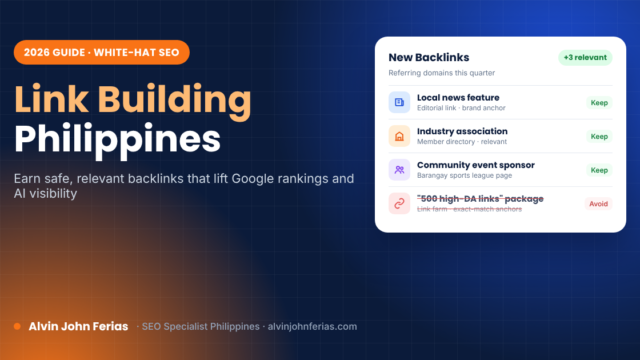
Learn how to earn links safely and why buying them is risky. My link building guide explains Google’s rules and the tactics that work.
7. AI Search: AIO and GEO
In 2026, clients ask whether ChatGPT, Gemini and Google AI Overviews mention their business. Learn how AI tools choose sources: answer-first content, schema, entity consistency, reviews and brand mentions. This skill alone can set you apart from many SEO specialists who only track Google rankings. See my AI SEO Philippines guide.
8. Reporting and Communication
Clients don’t pay for rankings. They pay for leads and sales. Learn to explain results in plain language, connect SEO work to business outcomes, and set honest expectations. No one can guarantee a #1 ranking, and good experts say so.
Tools to Learn
| Tool | Cost | What it’s for |
|---|---|---|
| Google Search Console | Free | Indexing, queries, clicks, technical issues |
| Google Analytics 4 | Free | Traffic, conversions and user behavior |
| PageSpeed Insights | Free | Core Web Vitals and speed |
| Google Business Profile | Free | Local SEO |
| Screaming Frog SEO Spider | Free up to 500 URLs | Site crawls and technical audits |
| Rank Math or Yoast (WordPress) | Free versions | Titles, meta, sitemaps, basic schema |
| Ahrefs, Semrush or Ubersuggest | Paid, some free limits | Keywords, backlinks, competitor research |
| ChatGPT, Gemini, Perplexity | Free tiers | Testing AI visibility and speeding up research |
Learn the free tools first. Many clients will give you access to their paid tools once you’re working with them.
A Step-by-Step Plan: Your First 6 Months
Knowing how to become an SEO expert is one thing. Doing it takes a plan. Here’s a realistic path for a beginner studying part-time.
- Month 1: Fundamentals. Study how search works and the basics of keyword research and on-page SEO. Set up a free WordPress site on a cheap domain, or volunteer to help a relative’s or friend’s small business.
- Month 2: Hands-on practice. Install Search Console and GA4, publish five to ten optimized pages, and set up a Google Business Profile if the business qualifies.
- Month 3: Technical and local SEO. Run a crawl, fix what you find, improve page speed, add schema and build local citations.
- Month 4: First portfolio piece. Write a short case study with before-and-after screenshots: what you found, what you changed, and what happened.
- Month 5: First paid work. Apply for SEO VA or junior roles, or offer a small local SEO package to nearby businesses.
- Month 6: Specialize and repeat. Choose a direction, such as local, technical, ecommerce or AI SEO, and start a second case study.
If you want structure and templates for this, my SEO Sparks course covers it in five days, from search basics to keyword research, on-page, technical and local SEO, link building and reporting. It includes 70+ templates and 10 portfolio assignments.
How to Build an SEO Portfolio With No Clients
Clients hire proof, not certificates. A strong beginner portfolio includes:
- One real website you improved, even if it’s your own blog or a family business.
- A short case study using Search Console screenshots: impressions, clicks and ranking changes over time.
- A sample SEO audit of a public website, showing what you’d fix and why.
- A keyword research sheet and a content brief for a real business.
- Testimonials, even from small or free projects.
Keep each case study honest and specific. “Impressions grew from 1,200 to 4,800 in 90 days after fixing indexing and rewriting 12 titles” is far more convincing than “I improved their SEO.”
Where to Find Your First SEO Clients or Jobs
- Job boards: JobStreet, OnlineJobs.ph, LinkedIn and Indeed list SEO VA and junior SEO roles every week.
- Local businesses: clinics, restaurants, contractors and service businesses near you often have weak websites and no Google Business Profile strategy.
- Agencies: many Philippine and overseas agencies hire juniors and train them. This is one of the fastest ways to learn.
- Your network: friends, former employers and community groups. Your first client is often someone who already trusts you.
- Government and community programs: DICT and local training programs often connect graduates with real projects and employers.
A tip from my SPARK trainings: the beginners who get hired fastest are rarely the ones with the most certificates. They are the ones who can show one real website they improved, explain what they did in simple words, and reply to clients quickly and professionally. Reliability and communication win as many SEO jobs as technical skill, especially with overseas clients.
How Much Do SEO Specialists Earn in the Philippines?
Pay depends on experience, skills and whether you work for local or overseas clients. Here’s what current sources show:
| Source | Role or basis | Pay shown |
|---|---|---|
| Indeed Philippines | Average SEO specialist base salary (448 salaries, updated May 2026) | ₱35,102 per month |
| JobStreet listings | Junior SEO specialist ad | ₱35,000 to ₱45,000 per month |
| JobStreet listings | Lead SEO specialist ad | ₱50,000 to ₱60,000 per month |
| JobStreet listings | SEO specialist ad | ₱60,000 to ₱80,000 per month |
| OnlineJobs.ph listing | Remote full-time SEO specialist ad | ₱70,000 to ₱90,000 per month |
These are snapshots, not guarantees. Pay rises fastest when you add technical SEO, AI search skills and a portfolio of measurable results. Freelance SEO experts set their own rates, usually as monthly retainers. My SEO pricing guide shows how client-side SEO is priced.
What Separates an SEO Expert From an SEO Specialist?
Many people learn how to become an SEO expert on paper, but stay at the specialist level for years. In my experience hiring and training SEO teams, the difference comes down to five habits:
- They diagnose before they act. A specialist runs the same checklist on every site. An expert asks why traffic changed, looks at the data, and fixes the actual cause.
- They understand the business. Experts know which pages make money, which leads matter and what the client’s sales process looks like. They prioritize work that moves revenue, not just rankings.
- They’re comfortable with technical problems. Experts can read a crawl report, spot a bad redirect chain or a noindex mistake, and talk to developers in their language.
- They adapt when search changes. Google updates, AI Overviews and new AI tools don’t scare them. They test, measure and adjust.
- They teach. Experts can explain SEO clearly to clients, train juniors and write about what they’ve learned. That ability is also what builds their own reputation and gets them recommended, by people and by AI tools.
You can start building these habits from your first project. Ask “why?” before every task, track results in Search Console, and write a short note about what you learned each month. Over time, those notes become blog posts, case studies and proof of expertise.
This is also how your own personal brand grows. When I wrote about how my website ranked #1 for “SEO expert Philippines”, I used the same habits: diagnose, fix, measure and document. If you’re figuring out how to become an SEO expert others trust, publishing what you learn is one of the most effective steps you can take.
7 Mistakes That Slow Down New SEO Specialists
- Watching endless tutorials without working on a real website.
- Chasing tool scores, such as “100/100 SEO score” in a plugin, instead of real rankings and leads.
- Buying cheap backlinks for clients, which can get their sites penalized.
- Promising guaranteed rankings to win a client.
- Ignoring technical SEO because it looks hard.
- Skipping AI search skills, even though clients now ask about them.
- Not documenting results, so there’s nothing to show the next client.
FAQ: How to Become an SEO Expert
Do I need a degree to become an SEO expert? No. Most SEO experts in the Philippines learned through courses, practice and real projects. Employers and clients care more about your portfolio and results than your diploma.
How long does it take to become an SEO expert? You can learn the basics in a few weeks and land first paid work within a few months. Becoming a true expert usually takes two to five years of hands-on work across different websites and industries.
Is SEO still a good career with AI search? Yes. AI tools still rely on websites, reviews and trusted sources, so businesses need people who understand both traditional SEO and AI search optimization. Job ads in the Philippines now list SEO, GEO and AI search skills together.
Can I learn SEO for free? Yes. Google’s SEO Starter Guide, Search Console, Analytics and many free tools are enough to learn the fundamentals. A structured course helps you learn faster and build a portfolio.
What’s the difference between an SEO specialist and an SEO expert? An SEO specialist usually carries out SEO tasks and campaigns. An SEO expert has enough experience to diagnose complex problems, set strategy and lead others. Most experts start as specialists.
Start Your SEO Career With the Right Foundation
If you’re serious about how to become an SEO expert, start with structure, real practice and a portfolio from week one. My SEO Sparks course is a 5-day SEO training for virtual assistants and freelancers. It covers search basics, keyword research, on-page, technical and local SEO, link building, reporting and building an SEO career, with 70+ templates and portfolio assignments.
You can also browse my other Sparks courses for social media, WordPress, GoHighLevel, general VA and e-commerce VA skills. For seminars and workshops for schools, LGUs and organizations, see my seminars page or contact me.
About the author: Alvin John Ferias is an SEO specialist in the Philippines with 15+ years of experience in technical, local and AI SEO, and a DICT resource speaker and SPARK trainer since 2018. A former programmer, he founded webdeveloper.com.ph in 2008, is CEO of To and Fro Digital Marketing Solutions and co-founder of Arrow Up Media. He works with clients in the Philippines, Australia, the US and the UK.