
By Alvin John Ferias, SEO Specialist, Philippines · Published: November 18, 2026 · 12 min read
Link building Philippines businesses can trust is about earning links from real, relevant websites, not buying hundreds of backlinks from sites nobody visits. Links are still one of the clearest signals Google uses to judge whether a website deserves to rank. They also shape which brands AI tools like ChatGPT, Gemini and Google AI Overviews mention. But the wrong kind of links can get a site penalized, and I have cleaned up enough of those to know how expensive that mistake is.
In more than 15 years of SEO work for Philippine and international clients, I have seen link building change from “more is better” to “relevant is everything.” This guide covers what a good backlink looks like in 2026, the strategies that work for Philippine businesses, how links affect AI search, and how to avoid the shortcuts that cause penalties.
Quick Answer: What Is Link Building?
Link building is the process of earning links from other websites to yours. Each relevant link acts like a vote of trust that helps your pages rank higher on Google and get mentioned more often in AI answers. Safe link building in the Philippines focuses on:
- Relevance: links from sites in your industry, location or audience.
- Real websites: sites with genuine readers and traffic, not link farms.
- Earned placement: links given because your content, business or story is worth citing.
- Natural anchor text: mostly your brand name and plain phrases, not exact-match keywords.
- Steady growth: a few quality links each month rather than a sudden spike.
- Compliance: paid or sponsored links marked with rel=”sponsored” or rel=”nofollow”, as Google requires.
For most local businesses, 5 to 10 strong, relevant links a year can move rankings more than 500 cheap ones.
Why Links Still Matter in 2026
Search has changed a lot, but links still do three jobs that nothing else replaces:
- Discovery. Google finds new pages by following links. A page with no links pointing to it may take a long time to be crawled.
- Authority. Links from trusted sites tell Google your site is trustworthy too. This matters most in competitive niches like legal, health, finance and real estate.
- Relevance. A link from a Philippine construction association tells Google more about a builder in Cebu than a link from a random overseas blog.
Links also feed AI search indirectly. AI tools build answers from sources they trust, and those sources are usually well-linked, frequently cited websites. When your brand is mentioned and linked on those sites, AI tools are more likely to connect your business with your service.
Google’s Link Spam Rules: What Gets Sites Penalized
Before any link building Philippines campaign starts, everyone involved should understand Google’s rules. Google’s spam policies define link spam as creating links primarily to manipulate search rankings. Examples Google lists include:
- Buying or selling links for ranking purposes, including paying money, goods or services for links or for posts that contain links.
- Excessive link exchanges (“link to me and I’ll link to you”).
- Automated programs or services that create links to your site.
- Large-scale guest posting or article campaigns with keyword-rich anchor links.
- Low-quality directory and bookmark sites, and links hidden in widgets or site footers.
Paid links are not banned outright. Google says they’re acceptable when marked with rel=”nofollow” or rel=”sponsored”. In its link spam update announcement, Google also warned that sites publishing or acquiring excessive sponsored and guest posts without proper link tags may face algorithmic and manual actions.
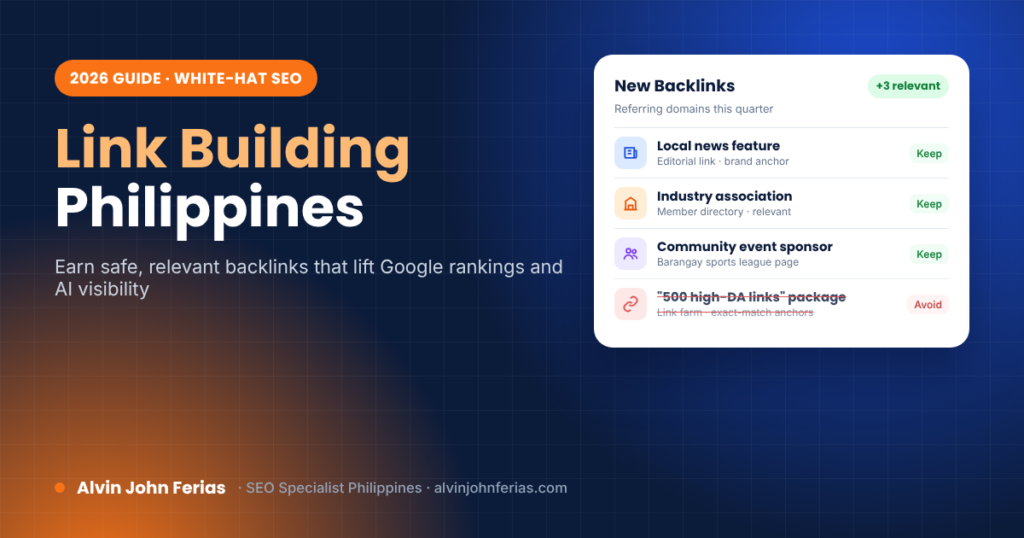
In practice, this means the cheap “100 high-DA backlinks for $50” packages sold in Facebook groups and freelance marketplaces are the riskiest thing you can buy for your website. At best Google ignores those links. At worst your site gets a manual action and disappears from search results.
What Makes a Good Backlink?
Not all links are equal. Before pursuing any link, I check it against five questions:
| Question | Good sign | Warning sign |
|---|---|---|
| Is the site relevant? | Same industry, location or audience | Unrelated topics, “write for us” on everything |
| Does it have real traffic? | Organic traffic and engaged readers | Authority score high but almost no traffic |
| Is the link editorial? | Placed in useful content, in context | Footer, sidebar or a page full of outbound links |
| Is the anchor text natural? | Brand name, URL or a natural phrase | Exact-match keyword every time |
| Would you want it with no SEO value? | It would bring customers or credibility | It exists only to pass “link juice” |
The last question is the best filter. If a link would be worth having even if Google ignored it, because it brings visitors, trust or partnerships, it’s almost always a good link.
10 Link Building Strategies That Work for Philippine Businesses
These are the safe, repeatable tactics I use in link building Philippines campaigns, starting with the easiest.
1. Claim Your Business Profiles and Citations
Start with the basics: Google Business Profile, Facebook, LinkedIn, and reputable Philippine business directories and industry listings. Keep your name, address and phone number identical everywhere. Most of these links are nofollow, but they build your entity and help local rankings.
2. Get Listed by Associations, Chambers and Partners
Membership in your chamber of commerce, industry association or professional body often comes with a member directory link. So do supplier, distributor and dealer pages. If you’re an authorized reseller, ask the brand to list you as a stockist.
3. Use Your Local Network
Sponsor a barangay event, school activity, sports league or charity drive. Local organizations often thank sponsors with a link. These links are highly relevant for local SEO and hard for competitors to copy.
4. Turn Existing Mentions Into Links
Search Google for your business name in quotes. You’ll often find news articles, blog posts or event pages that mention you without a link. A short, polite email asking the site to add a link usually works.
5. Publish Data and Original Research
Journalists and bloggers link to original numbers. Survey your customers, analyze your own sales or service data, or compile local pricing information. A post like “Average Aircon Cleaning Prices in Metro Manila 2026” can earn links for years.
6. Create Genuinely Useful Resources
Guides, checklists, calculators and templates attract links naturally. Think permit checklists for new businesses, size charts, maintenance schedules or step-by-step how-tos. My own AI visibility study is an example of content built to be cited.
7. Digital PR and Local Media
Pitch real stories to local news sites, business publications and lifestyle blogs: a founder story, a milestone, a community project or expert commentary on a trend. One feature in a respected publication is worth more than dozens of directory links.
8. Guest Posts on Relevant Sites, Done Properly
Guest posting still works when the site is relevant, the content is genuinely useful and the link is natural. Write for industry blogs your customers actually read. Avoid sites that publish anything for a fee, and never use the same keyword anchor across many posts.
9. Expert Quotes and Interviews
Journalists and bloggers regularly look for expert sources. Answer media requests, join podcasts, and speak at events or webinars. As a DICT resource speaker, many of my own mentions come from event pages and training announcements.
10. Recover Broken and Lost Links
Check Search Console and a backlink tool for links pointing to pages that now return 404 errors. Redirect those URLs to the right page so you keep the value. You can also find broken links on other sites and suggest your page as a replacement.
A 90-Day Link Building Plan for a Local Business
If you’re starting from zero, here’s a realistic first quarter for a link building Philippines campaign. It assumes a small local business with a working website and Google Business Profile.
- Weeks 1 to 2: Audit and foundations. Check your current backlinks in Search Console, fix broken pages that already have links, and make sure your name, address and phone number are consistent across your profiles.
- Weeks 3 to 4: Easy wins. Claim the remaining business profiles and reputable directories in your industry. Ask suppliers, partners and associations you already belong to for a listing.
- Weeks 5 to 8: Create one linkable asset. Publish a local guide, price survey or checklist your customers and local media would find useful. Turn any unlinked brand mentions into links.
- Weeks 9 to 12: Outreach. Pitch your asset to five to ten relevant local blogs, publications or community pages. Offer a quote or a guest article where it genuinely fits.
By the end of the quarter, you should have a cleaner profile, a handful of relevant new links and a piece of content that keeps earning links over time. Repeat the asset and outreach cycle every quarter.
Link Building for AI Search: AIO and GEO
AI Optimization (AIO) and Generative Engine Optimization (GEO) change what a “good link” means. AI tools don’t count links the way Google’s algorithm does. Instead, they learn which brands are associated with which topics from the sources they read and cite. So link building Philippines brands do in 2026 should also aim for mentions in the places AI trusts:
- “Best of” lists and roundups in your industry and city. AI answers to “best dentist in Quezon City” often draw on these.
- Reputable news and industry publications, which are heavily represented in AI training and search data.
- Community discussions on Reddit and Facebook groups where real people recommend businesses.
- Review platforms and Google Business Profile reviews that describe your services in detail.
- Consistent brand descriptions. When every mention describes you the same way, such as “a Manila-based accounting firm for small businesses,” AI tools connect your name to that service more confidently.
A useful test: ask ChatGPT, Gemini and Perplexity who they recommend for your service and location. Note which sites they cite. Those sites are your highest-priority link and mention targets. My AI SEO Philippines guide explains this approach in more depth.
Technical Link SEO: Make Every Link Count
Earning links is only half the job. Your site has to make good use of them.
- Link to pages that can rank. Point links at service pages and strong content, not thin pages.
- Use internal links to spread authority. A blog post that earns links should link to your main service pages.
- Keep linked URLs live. If you change a URL, set a 301 redirect so incoming links still count.
- Use the right rel attributes on your own site. Mark paid and affiliate links as rel=”sponsored”, and comment or forum links as rel=”ugc”.
- Make sure linked pages are indexable. A link to a noindexed or blocked page is wasted.
My technical SEO checklist covers redirects, indexing and internal linking in detail.
Auditing Your Backlinks and When to Disavow
Check your backlink profile at least every quarter in Google Search Console’s Links report and a tool like Ahrefs, Semrush or Ubersuggest. Look for:
- Sudden spikes of links from unrelated or foreign-language spam sites.
- Large numbers of links with exact-match keyword anchors.
- Links from sites selling links openly.
- Manual action messages in Search Console.
Most sites never need to disavow anything, because Google already ignores most spam links. Use Google’s disavow tool only if you have a manual action for unnatural links, or you know a past SEO provider built large numbers of paid or spam links. Disavowing good links by mistake can hurt rankings, so do it carefully.
How Much Does Link Building Cost in the Philippines?
Link building Philippines providers usually price their work in one of three ways: per link, as a monthly retainer, or as part of a full SEO package. Cost depends on how competitive your industry is, the quality of the sites involved and how much content or outreach each link needs.
A safe rule: real outreach takes real time. Someone has to research sites, write a pitch or an article, follow up and track results. When a package promises dozens of high-authority links for a few hundred pesos, the links almost certainly come from link farms or private blog networks (PBNs).
In my own work, link building is part of the overall SEO plan rather than a separate product, and backlink analysis is included in my standard and power SEO plans. You can see how ongoing SEO is priced in my SEO pricing guide.
Red Flags in Link Building Services
- Guaranteed numbers of “high DA” or “high DR” links for a low fixed price.
- No list of the actual sites where your links will appear.
- Links delivered within days, all at once.
- Sites with unrelated topics and no real traffic.
- Exact-match keyword anchors on every link.
- Refusal to explain how links are obtained.
Should You Build Links Yourself or Hire a Specialist?
Many link building tactics are things a business owner can do: claiming profiles, joining associations, sponsoring local events and asking partners for links. These are often the most valuable links you’ll get, because they come from real relationships.
Hire a specialist when you’re in a competitive market, when you need digital PR or content-led campaigns, or when your backlink profile already has problems from past spam. A specialist also knows which links to skip, which saves you from expensive mistakes. See how I work as an SEO specialist in the Philippines.
How to Measure Link Building Results
| Metric | Where to find it |
|---|---|
| New referring domains per month | Search Console Links report, Ahrefs, Semrush or Ubersuggest |
| Rankings for target pages | Rank tracker, Search Console |
| Referral traffic from linked sites | GA4, Traffic acquisition report |
| Brand mentions and AI citations | Manual checks in ChatGPT, Gemini and Perplexity |
| Leads from organic and referral traffic | GA4 events, calls and form submissions |
Expect link building to take time. Most sites see ranking changes 2 to 6 months after new links are indexed, depending on competition.
FAQ: Link Building Philippines
What is link building? Link building is the process of earning links from other websites to yours. Relevant links act as votes of trust that help your pages rank higher on Google and get mentioned more often in AI answers.
Is buying backlinks safe? No, not for ranking purposes. Google’s spam policies treat buying links to manipulate rankings as link spam. Paid links are allowed only when marked with rel=”sponsored” or rel=”nofollow”, which means they don’t pass ranking value.
How many backlinks do I need to rank in the Philippines? There’s no fixed number. It depends on your competitors. Many local businesses rank well with a small number of strong, relevant links plus a good Google Business Profile and website.
How long does link building take to work? Most sites see ranking changes 2 to 6 months after new links are indexed. Competitive industries and new websites usually take longer.
Do backlinks help with ChatGPT and Google AI Overviews? Yes, indirectly. AI tools rely on trusted, well-linked sources. Being mentioned and linked on those sites helps AI connect your brand with your service.
Build Links the Safe Way
If your competitors outrank you, or you’re worried about links a past provider built, start with a backlink review. As part of my link building Philippines work, I’ll check your current links, flag anything risky, and map out the relevant sites, associations and media your business should be on. You work directly with me, not an account manager.
Request your free SEO audit, call or message +63 992 835 6312, or email alvinjohnf@gmail.com.
About the author: Alvin John Ferias is an SEO specialist in the Philippines with 15+ years of experience in technical, local and AI SEO. He is the CEO of To and Fro Digital Marketing Solutions, co-founder of Arrow Up Media, founder of webdeveloper.com.ph and a DICT resource speaker since 2018. He works with clients in the Philippines, Australia, the US and the UK.