By Alvin John Ferias, SEO Specialist, Philippines · Published: October 29, 2026 · 9 min read
An SEO audit in the Philippines is the fastest way to find out why your website isn’t ranking, isn’t getting leads, or quietly lost traffic after an update or redesign. Instead of guessing, an audit checks your site the way Google and AI search tools see it, then ranks every problem by how much it is costing you.
I’ve been building and optimizing websites since 2008, and I prepare audit reports for clients in the Philippines, Australia, the US and the UK every month. This guide shows you exactly what I check, what the report should give you, and how to tell a useful audit from an automated PDF.
Quick Answer: What Is an SEO Audit?
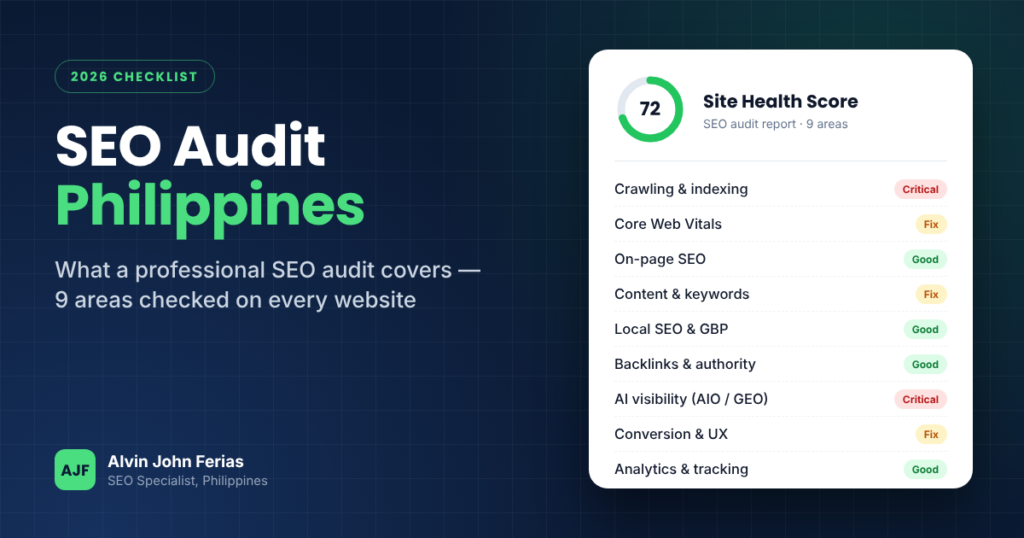
An SEO audit is a full health check of your website’s search performance. A professional audit reviews nine areas:
- Crawling and indexing
- Site speed and Core Web Vitals
- On-page SEO
- Content quality and keyword coverage
- Local SEO and Google Business Profile
- Backlinks and authority
- AI search visibility (AIO and GEO)
- Conversion and user experience
- Analytics and tracking
The output is a prioritized action plan, not just a list of errors. For most Philippine small and medium business websites, a thorough audit takes 5 to 10 working days.
Why Philippine Businesses Need an SEO Audit in 2026
Search has changed more in the last two years than in the decade before it. Customers in Manila, Cebu, Davao and the provinces now find businesses through Google results, Google Maps, AI Overviews, ChatGPT and Gemini. A website that was “fine” in 2023 can be invisible in 2026.
An audit matters because most ranking problems are invisible from the front end. Your homepage can look perfect while Google is ignoring half your pages, indexing the wrong version of your site, or reading a slow mobile experience as a reason to rank a competitor first.
Signs It’s Time for an SEO Audit
- Traffic dropped after a Google core update, a hosting move or a website redesign.
- You rank on page 2 or 3 for your main service keywords and can’t break through.
- Leads are flat even though traffic looks steady.
- New pages don’t show up in Google weeks after publishing.
- Your competitors appear in AI Overviews and ChatGPT answers, but your brand doesn’t.
- You’re about to hire an SEO provider and want a baseline to measure them against.
- You’ve never had one. If the site is more than a year old, there are issues waiting to be found.
The most common culprits I find are indexing gaps, slow mobile pages and weak internal linking — none of which show up when you simply look at your homepage.
The SEO Audit Checklist: 9 Areas I Check on Every Website
1. Crawling and Indexing
If Google can’t crawl a page, nothing else matters. This is always where I start, and it connects directly to website crawlability.
- Pages indexed in Google Search Console vs pages that should be indexed
- robots.txt rules blocking important folders or resources
- XML sitemap: present, submitted, and free of redirected or noindex URLs
- Canonical tags pointing to the right version (https, www or non-www, trailing slash)
- Noindex tags left on by mistake — very common after a staging site goes live
- Redirect chains, redirect loops and 404 pages that still receive links
- Duplicate and thin pages created by tags, filters or WooCommerce parameters
2. Site Speed and Core Web Vitals
Most Filipino searchers are on mobile data, so speed is a ranking and conversion issue at the same time. I test key templates in PageSpeed Insights and check field data in Search Console against Google’s “good” thresholds:
| Metric | What it measures | Good score |
|---|---|---|
| Largest Contentful Paint (LCP) | How fast the main content loads | 2.5 seconds or less |
| Interaction to Next Paint (INP) | How quickly the page responds to taps and clicks | 200 ms or less |
| Cumulative Layout Shift (CLS) | How much the layout jumps while loading | 0.1 or less |
On WordPress sites, the usual causes are oversized images, too many plugins, heavy page builders, render-blocking scripts and cheap shared hosting. Good hosting is often one of the quickest fixes.
3. On-Page SEO
- One clear, keyword-focused title tag per page (roughly 50 to 60 characters)
- Meta descriptions that earn the click, not just describe the page
- One H1 per page and a logical H2/H3 structure
- Clean, short URLs that include the main keyword
- Image file names and alt text
- Internal links using descriptive anchor text, with no orphan pages
- Keyword cannibalization: two or more pages competing for the same search
4. Content Quality and Keyword Coverage
I map every important page to the keyword it should rank for, using local keyword research as the base. Then I look for gaps.
- Service pages that are too short to answer a buyer’s real questions
- Missing pages for services, locations or industries you actually serve
- Outdated content with old prices, dates or screenshots
- Signs of E-E-A-T: author names, credentials, real photos, case studies and reviews
- AI-generated text that reads generic and adds nothing new
5. Local SEO and Google Business Profile
For clinics, law firms, contractors, restaurants and any business serving a specific city, local SEO often brings the fastest wins. I cover this in depth in my guide to local SEO in Manila.
- Google Business Profile: correct category, complete services, photos, posts and review replies
- NAP consistency (name, address, phone) across your site, Facebook and directories
- Location pages with real local content, not just a swapped city name
- LocalBusiness schema with address, hours and geo-coordinates
- Review volume and recency compared with the top three competitors in the Map Pack
6. Backlinks and Authority
- Referring domains and how they compare with the sites ranking above you
- Toxic or spammy links from paid link schemes
- Broken backlinks pointing to deleted pages (easy wins with a redirect)
- Anchor text balance — too many exact-match anchors is a warning sign
- Mentions of your brand without a link, which can often be converted
7. AI Search Visibility (AIO and GEO)
This is the part most audits in the Philippines still skip. Google AI Overviews, ChatGPT, Gemini and Perplexity now answer questions directly and cite a handful of sources. I check whether your business is one of them. My AI SEO guide explains the strategy behind it.
- Whether AI tools mention your brand for your main service queries
- Answer-first formatting: a short, direct answer near the top of key pages
- FAQ sections written in the way people actually ask questions
- Structured data: Organization, Person, LocalBusiness, Service, FAQPage and Article schema
- Entity consistency: the same business name, founder, location and services everywhere online
- Whether robots.txt blocks AI crawlers you actually want to allow
8. Conversion and User Experience
Ranking only pays if visitors take action. I review each money page the way a customer would. This ties into how websites generate leads.
- A clear call to action above the fold on mobile
- Click-to-call, Messenger and Viber options for Filipino customers
- Short contact forms that work and send to the right inbox
- Trust signals: reviews, client logos, certifications and real team photos
- Accessibility basics like contrast, font size and tap targets — see why accessibility supports SEO
9. Analytics and Tracking
- Google Analytics 4 and Search Console installed and verified
- Conversions tracked: form submissions, calls, Messenger clicks and purchases
- No duplicate tracking codes inflating your numbers
- A baseline report so you can measure the impact of every fix
Without tracking, an audit can tell you what’s broken but not what fixing it was worth.
How I Run an SEO Audit: Step by Step
An automated tool can scan a site in five minutes. A real audit adds the judgment: what matters for your business, what to fix first, and what to ignore. Here is the process I follow.
- Discovery call. I learn your business goals, target customers, service areas and the keywords that actually bring revenue.
- Access and data collection. Read-only access to Google Search Console, GA4 and, if available, your Google Business Profile. This shows real performance, not estimates.
- Full site crawl. I crawl every URL to find technical errors, duplicate content, broken links and indexing problems.
- Manual review. I check key pages by hand on mobile and desktop — service pages, location pages, the homepage and top blog posts.
- Competitor benchmark. I compare your site with the three to five competitors ranking above you on Google and in AI answers.
- AI visibility check. I test how ChatGPT, Gemini, Perplexity and Google AI Overviews respond to the questions your customers ask.
- Prioritized report. Every issue is scored by impact and effort, so you know exactly what to fix first.
- Walkthrough call. I explain the findings in plain language and answer your team’s or developer’s questions.
What You Should Receive
| Deliverable | Why it matters |
|---|---|
| Executive summary | The top issues and expected impact, readable in five minutes |
| Prioritized fix list | Each issue rated high, medium or low, with who should fix it |
| Technical findings | Crawl, indexing, speed and schema errors with example URLs |
| Content and keyword map | Which page should rank for which keyword, plus content gaps |
| Local and AI visibility review | Map Pack and AI citation standing against competitors |
| 90-day action plan | Quick wins for month one, bigger projects for months two and three |
If an audit report doesn’t tell you what to do first, it’s a scan, not an audit.
How Much Does an SEO Audit Cost in the Philippines?
The price of an SEO audit depends on the size and complexity of the site, not on a fixed package. The main factors are:
- Number of pages. A 15-page service website is very different from a 5,000-product WooCommerce store.
- Scope. Technical-only audits cost less than full audits that include content, local, backlink and AI visibility reviews.
- Number of locations. Multi-branch businesses need a local review for each branch.
- Competitor depth. More competitors benchmarked means more analysis time.
- Implementation. Some providers only report; others also fix the issues.
[Alvin: add your audit price or starting rate here, or link to your quote form.]
For ongoing SEO pricing after the audit, see my 2026 SEO pricing guide for the Philippines. Be cautious with “free SEO audits” that are just a tool export with your logo on it — they rarely include prioritization or manual review.
DIY SEO Audit vs Professional SEO Audit
| DIY audit | Professional audit | |
|---|---|---|
| Cost | Free tools or low-cost subscriptions | One-time fee |
| Time | 2 to 4 weeks of your own time | 5 to 10 working days |
| Depth | Surface-level errors flagged by tools | Root causes plus business context |
| Prioritization | You decide what matters | Ranked by impact on traffic and leads |
| AI visibility | Usually not covered | Checked against real AI answers |
| Best for | Very small sites and learners | Businesses that depend on leads from search |
If you want to try it yourself first, start with free tools: Google Search Console, PageSpeed Insights, the Rich Results Test and the free tier of a site crawler. Fix the indexing and speed issues first — those affect every other page.
Common SEO Audit Findings on Philippine Websites
These are the issues I see again and again on local business sites:
- Staging or “coming soon” pages still indexed, or the live site still set to noindex
- Both http and https, or www and non-www, versions of the site accessible
- Hero images of 2 to 5 MB slowing down mobile pages
- One generic “Services” page instead of a page per service
- No location pages for the cities the business actually serves
- Google Business Profile with the wrong primary category
- No schema markup at all
- Contact forms that silently fail to deliver emails
- GA4 installed but no conversions tracked
Most of these are quick fixes once they’re found. That’s why an audit usually pays for itself early.
How to Choose the Right SEO Auditor
Ask these questions before you hire anyone. My step-by-step guide on how to hire an SEO expert in the Philippines goes deeper.
- Can I see a sample audit report? A good auditor will show you one, with client details removed.
- Do you review pages manually, or only run tools?
- Do you check AI search visibility and schema? In 2026, this should be standard.
- Will you prioritize the fixes and explain them to my developer?
- Can you also implement the fixes? If not, ask who will.
- What results have you achieved on your own site? I documented how this website ranked #1 for “SEO expert Philippines”.
Frequently Asked Questions About SEO Audits
How often should I get an SEO audit?
A full SEO audit once a year is enough for most business websites. Run an extra one after a redesign, a platform or hosting migration, a sudden traffic drop, or a major Google update.
How long does an SEO audit take?
For a typical Philippine SME website of 20 to 200 pages, a thorough audit takes 5 to 10 working days. Large e-commerce sites can take longer.
Will an SEO audit improve my rankings by itself?
No. An audit finds the problems and tells you what to fix first. Rankings improve when the fixes are implemented, usually within weeks for technical issues and within a few months for content and authority work.
What access do you need for an SEO audit?
Read-only access to Google Search Console and Google Analytics 4 is ideal. WordPress admin access helps but isn’t required for the audit itself.
Do you audit websites outside the Philippines?
Yes. I audit websites for businesses and agencies in Australia, the United States, the United Kingdom and the Philippines, including white-label audits for agencies.
What’s the difference between an SEO audit and a technical SEO audit?
A technical SEO audit covers crawling, indexing, speed and code. A full SEO audit adds content, keywords, local SEO, backlinks, AI visibility and conversion.
Get a Professional SEO Audit for Your Website
If your website isn’t bringing in the traffic or leads it should, an audit is the right first step. You’ll know exactly what’s holding you back and what to fix first — no guesswork.
Book your SEO audit or message me on Messenger. You can also call +63 992 835 6312.
Want ongoing support after the audit? See my SEO services and AI SEO services.