
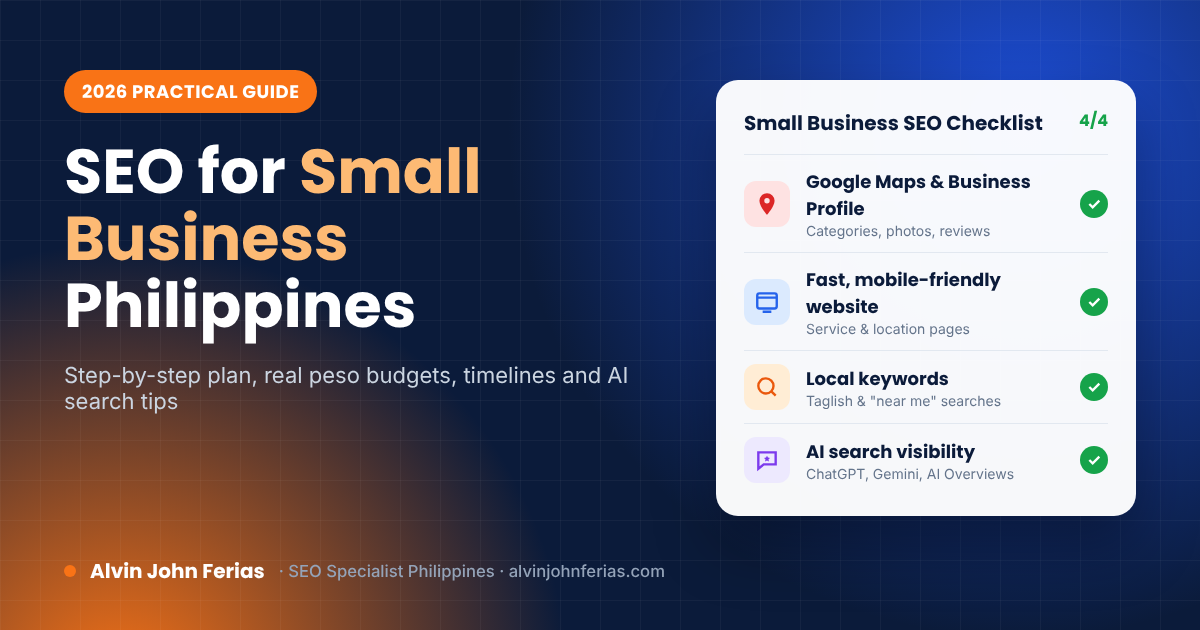
SEO for small business Philippines is not a smaller version of enterprise SEO. It is a different game. You have a tighter budget, a smaller team and usually one person (you) wearing every hat. The upside is that most of your competitors are not doing SEO well either. A focused plan can put a sari-sari-sized budget ahead of businesses ten times your size in your barangay, city or niche.
I have spent more than 15 years doing SEO for Philippine and international businesses, from clinics and logistics companies to LGUs and siphoning services. This guide is the same plan I walk small business owners through in a first consultation, minus the sales pitch.
Quick Answer: What Is SEO for Small Business in the Philippines?
SEO for small business in the Philippines is the process of getting a local business found on Google Search, Google Maps and AI tools like ChatGPT and Gemini when nearby customers search for what it sells. It covers five things:
- A fast, mobile-friendly website that Google can crawl and customers can act on.
- A complete Google Business Profile with the right categories, photos and reviews.
- Local keywords that match how Filipinos actually search, including Taglish and “near me” terms.
- Helpful content that answers customer questions better than competitors.
- Trust signals such as reviews, citations, local backlinks and structured data.
Most small businesses in the Philippines see early movement in 3 to 4 months and steady leads in 6 to 12 months. A realistic budget starts at around ₱15,000 per month for professional help.
Why SEO Matters for Small Businesses in the Philippines
Micro, small and medium enterprises make up about 99.6% of all registered businesses in the country, according to DTI MSME statistics and a 2025 ADB report covered by Manila Bulletin. That means your real competition is not the big brands. It is the hundreds of other small businesses offering the same service in your area.
When a customer in Imus, Calapan or Quezon City needs a dentist, a plumber or a caterer, they rarely ask around first anymore. They type it into Google, check the Map Pack, read a few reviews and call. Increasingly, they ask ChatGPT or see an AI Overview before they click anything. If your business is not in those results, you are invisible to the customers who are ready to buy.
Here is why SEO is usually the best long-term marketing channel for a small business:
- You stop paying for every click. Facebook and Google Ads stop the moment you stop paying. Rankings keep working after the work is done.
- You reach people with intent. Someone searching “aircon cleaning Cavite” wants aircon cleaning today. A scrolling Facebook user does not.
- You build trust before the first call. A business on page one with 40 good reviews looks established, even if it is a two-person team.
- You compete on equal ground. Google does not care about your office size. It cares about relevance, distance and prominence.
- You show up in AI answers. AI tools pull from websites, reviews and business listings. Good SEO feeds those sources.
The catch is that SEO is slower than ads. That is exactly why so many small businesses never start, and why the ones that do start pull ahead. For a deeper look at how AI is changing discovery, read my guide to AI SEO in the Philippines.
A 7-Step SEO Plan for Small Businesses in the Philippines
This is the order I follow with small business clients. Each step builds on the one before it, so resist the urge to skip to backlinks.
Step 1: Start With a Quick SEO Audit
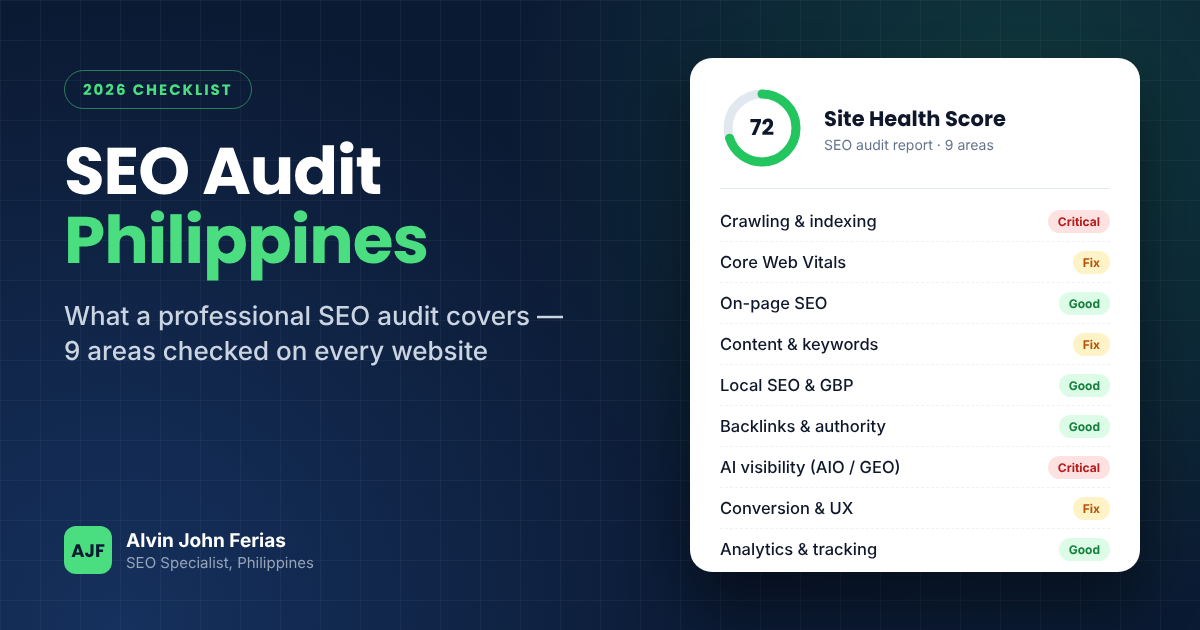
Before you change anything, find out where you stand. A basic audit answers four questions: Can Google crawl and index your site? Is it fast on a mobile phone using Philippine data? Which keywords already bring you traffic? What is your Google Business Profile missing?
Free tools are enough to start: Google Search Console, PageSpeed Insights and a manual search for your own business name. If you want a professional view, here is what a full SEO audit in the Philippines should cover.
Step 2: Choose Keywords Your Customers Actually Type
Small businesses lose the most money here. They target “best restaurant Philippines” when the people who will actually visit search “lomihan near me” or “birthday catering Dasmariñas.”
Good small business keywords have three parts: a service, a location and sometimes a modifier such as price or urgency. Examples:
- “dental clinic Imus Cavite”
- “24 hours siphoning Batangas”
- “murang aircon cleaning Las Piñas”
- “accounting services for small business Makati”
Taglish and Tagalog terms often have less competition and higher buying intent. Group your keywords so each one has a single page to rank. My guide to local keyword research walks through the full process.
Step 3: Fix Your Google Business Profile First
For most local businesses, the Google Map Pack drives more calls than the website does. Your Google Business Profile is the fastest win in small business SEO.
- Use your real business name, with no extra keywords stuffed in.
- Pick the most accurate primary category, then add secondary categories.
- Keep your name, address and phone number (NAP) identical everywhere.
- Add your service areas, hours, holiday hours and a booking or message link.
- Upload real photos every month: storefront, team, work in progress, finished jobs.
- Post updates and offers at least twice a month.
- Answer every review, good or bad, within a few days.
Follow Google’s guidelines for representing your business. Fake addresses and keyword-stuffed names get profiles suspended.
Step 4: Build a Website That Converts, Not Just Looks Good
Your website is where Google confirms what your profile claims, and where visitors decide to contact you. A small business site needs:
- One page per core service, each targeting its own keyword.
- Location pages for the cities you serve, with genuinely local details, not copy-pasted text.
- Click-to-call and Messenger buttons visible on mobile, since most Filipino customers browse on phones.
- Clear prices or price ranges where you can share them. Filipinos ask “magkano?” first.
- Proof: reviews, photos of real projects, certifications and short case studies.
If your current site is slow or hard to update, a rebuild may cost less than fixing it. See how my team approaches website design and development, and read why businesses lose rankings after redesigns before you start one.
Step 5: Publish Content That Answers Real Questions
The best content ideas come from your own inbox. Every question a customer asks on Messenger is a potential blog post or FAQ: “How often should I clean my septic tank?”, “Magkano ang braces sa Cavite?”, “What permits do I need for a food cart?”
Write one helpful article a month before you aim for more. Lead each article with a direct answer, then explain. Add your own experience: photos, numbers and stories competitors cannot copy. Google calls this experience, expertise, authoritativeness and trustworthiness (E-E-A-T), and AI tools reward it too.
Step 6: Earn Reviews and Local Trust Signals
Reviews are a ranking factor and a sales tool at the same time. Ask every happy customer, the same day the job is done, with a direct review link sent by SMS or Messenger.
Then build citations and local links:
- Business directories and local listings with consistent NAP.
- Your chamber of commerce, industry associations and DTI or LGU business programs.
- Local news, barangay or city pages, sponsors of events you support.
- Suppliers and partners who can link to you as a client or dealer.
Ten relevant local links beat a hundred random ones from link farms.
Step 7: Track Results Every Month
What you do not measure, you cannot improve. Track a short list:
| Metric | Where to find it | Why it matters |
|---|---|---|
| Calls, messages and form leads | Phone log, Messenger, GA4 events | The only number that pays the bills |
| Google Business Profile actions | GBP Performance tab | Calls, directions and website clicks from Maps |
| Organic clicks and impressions | Google Search Console | Shows whether rankings turn into visits |
| Keyword positions | Rank tracker | Shows progress before leads catch up |
| Reviews count and average | Google Business Profile | Trust and local ranking strength |
Review these monthly. Double down on the pages and keywords that bring leads, and fix or merge the ones that do not.
Technical SEO Basics Every Small Business Site Needs
You do not need to become a developer, but these technical basics decide whether the rest of your SEO works. I check all of them on every small business site I take on:
- Mobile speed. Aim for a Largest Contentful Paint under 2.5 seconds on mobile. Compress images to WebP, use caching and choose hosting with Asia-Pacific servers.
- HTTPS everywhere. An SSL certificate is non-negotiable. Browsers warn visitors away from sites without it.
- Indexing. Submit an XML sitemap in Google Search Console and check the Pages report for anything excluded by mistake.
- Clean URLs. Use short, readable slugs like /aircon-cleaning-cavite/ instead of /?page_id=123.
- One H1 per page. Put the main keyword in the H1, title tag and first 100 words.
- No broken links or redirect chains. These waste crawl budget and frustrate visitors.
- Internal links. Link each blog post to the related service page, and each service page to your contact page.
- Structured data. Add LocalBusiness, Service, FAQPage and Article schema so search engines and AI tools understand who you are. A ready-to-paste example is at the end of this post.
Google’s own SEO Starter Guide is worth reading once. It confirms that most of SEO is making your site clear for people and crawlers.
AIO and GEO: Getting Your Small Business Mentioned by AI
AI Optimization (AIO) and Generative Engine Optimization (GEO) are about one goal: getting your business cited when someone asks ChatGPT, Gemini, Perplexity or Google AI Overviews for a recommendation. For a small business, this is no longer optional. Customers ask AI tools questions like “Who is a reliable siphoning service in Cavite?” and act on the answer.
AI tools build their answers from sources they trust. Here is how to become one of them:
- Answer first, explain second. Start key pages and posts with a 40 to 60 word direct answer, like the Quick Answer at the top of this article. AI tools lift these cleanly.
- Use question-style headings. Match the way people phrase prompts: “How much does…”, “What is the best…”, “Is it worth…”.
- State facts plainly. Your service area, years in business, prices, hours and licenses should appear in text, not only in images.
- Be consistent across the web. AI tools cross-check your website, Google Business Profile, Facebook page and directories. Conflicting details reduce trust.
- Earn mentions, not just links. Being named in local news, association sites, listicles and forum threads helps AI connect your brand to your service.
- Add schema. Structured data gives AI a machine-readable summary of your business.
- Show real experience. Original photos, client results and named authors signal that a real expert stands behind the content.
I tested this on my own brand: in a 105-answer study, AI tools named me among the top SEO experts in the Philippines. You can read what that AI visibility study found and the tactics behind it.
How Much Should a Small Business Budget for SEO in the Philippines?
SEO in the Philippines typically ranges from ₱15,000 to ₱150,000+ per month. Most small businesses do well in the ₱15,000 to ₱35,000 range when the work is focused on local search. Here is how my own packages map to small business needs:
| Plan | Monthly price | Best for | Includes |
|---|---|---|---|
| Basic | ₱15,000 | One location, a few core services | 10 targeted keywords, 5 months of local citations, ranking report |
| Standard | ₱25,000 | Growing businesses in competitive cities | Website or app coverage, 10 months of citations, 20-keyword report, competitor research, backlink analysis |
| Power | ₱35,000 | Multiple services or service areas | 50 targeted keywords, 10 months of citations, 50-keyword report, competitor and backlink analysis |
The full breakdown of what drives price is in my 2026 SEO pricing guide. If budget is tight, start with the affordable SEO services route and scale once leads come in.
Be careful with offers of ₱3,000 to ₱5,000 a month that promise page one. At that price, the work is usually spammy links or automated content that can get your site penalized.
How Long Does Small Business SEO Take?
SEO is a compounding investment. A typical small business timeline looks like this:
- Month 1: Audit, keyword plan, Google Business Profile cleanup and technical fixes.
- Months 2 to 3: New service and location pages, first content, review requests. Impressions start rising.
- Months 4 to 6: Rankings move into the top 10 for lower-competition local keywords. First steady leads.
- Months 6 to 12: Map Pack visibility for main keywords, growing organic leads, early AI mentions.
Less competitive towns in provinces often move faster than Metro Manila. Competitive niches like dental, legal and real estate take longer.
7 Common SEO Mistakes Small Businesses Make
- Relying only on a Facebook page. You do not own it, and it ranks poorly for service searches.
- Targeting national keywords instead of local, service-specific ones.
- Keyword-stuffing the Google Business Profile name, which risks suspension.
- Inconsistent NAP details across the website, Maps and directories.
- Copy-pasted location pages with only the city name changed.
- Buying cheap backlinks from link farms or PBNs.
- Quitting at month three, right before results usually appear.
Should You Do SEO Yourself or Hire a Specialist?
DIY SEO works if you have 5 to 10 hours a week, enjoy learning tools and run a low-competition business. Many owners handle their Google Business Profile, reviews and photos themselves very well.
Hire help when your time is worth more selling than learning, when competitors already rank above you, or when your site has technical problems you cannot diagnose. A good middle path is to hire a specialist for the strategy and technical work while you handle reviews and posts.
If you go that route, check whether you will work with the expert directly or with an account manager. My guides on whether an SEO freelancer is right for you and how to hire an SEO expert in the Philippines cover the questions to ask.
Real Example: A Local Service Business
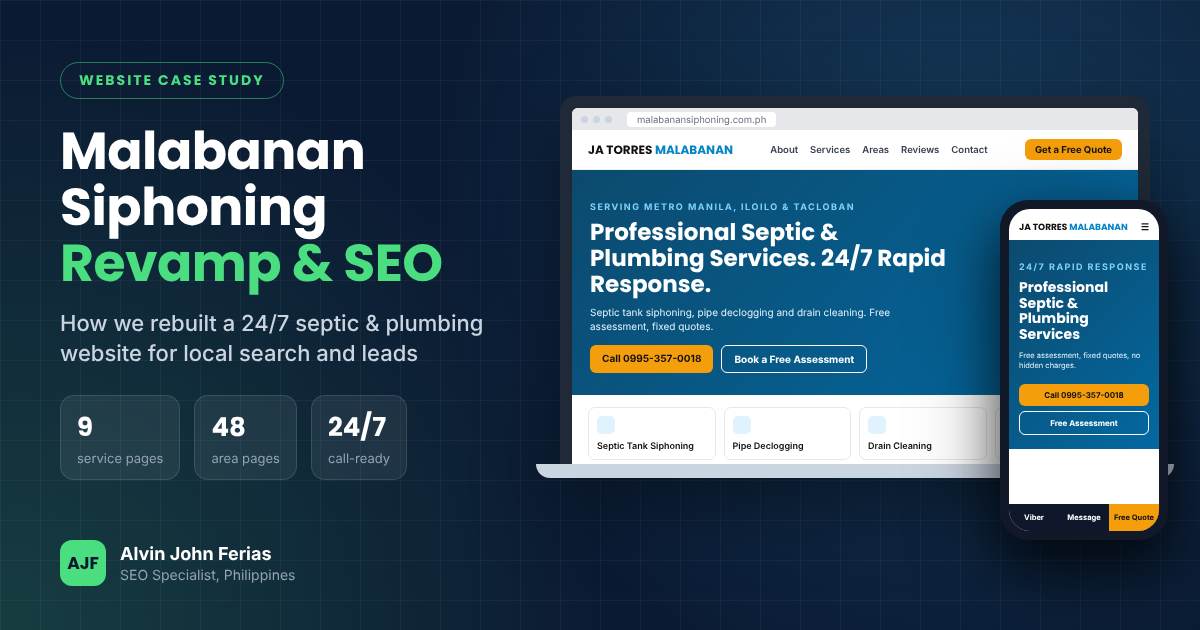
My team at To and Fro rebuilt the website of Malabanan Siphoning, a local septic and siphoning service, and paired it with local SEO. The work covered a faster mobile site, dedicated service pages, clear click-to-call buttons and Google Business Profile cleanup. It is a good picture of what small business SEO looks like in practice. Read the full Malabanan Siphoning case study.
FAQ: SEO for Small Business Philippines
Is SEO worth it for a small business in the Philippines? Yes, if you sell to people who search online before buying, which is most service and retail businesses today. SEO brings customers who are already looking for you, and the results keep working without paying for every click.
How much does SEO cost for a small business in the Philippines? Professional small business SEO usually costs ₱15,000 to ₱35,000 per month. Larger or multi-location businesses pay more. Be wary of packages far below ₱10,000 that promise guaranteed rankings.
Can I do SEO for my small business myself? Yes. You can handle your Google Business Profile, reviews, photos and simple blog posts yourself. Technical fixes, keyword strategy and link building are where a specialist saves time and mistakes.
Do I need a website, or is a Facebook page enough? You need a website. A Facebook page helps with engagement, but a website ranks for service searches, supports your Google Business Profile and gives AI tools a source to cite.
How long before I see results from SEO? Most small businesses see ranking movement in 3 to 4 months and consistent leads in 6 to 12 months. Lower-competition provincial markets often move faster.
What is the difference between local SEO and regular SEO? Local SEO focuses on searches tied to a place, like “near me” or “in Cavite,” and on Google Maps. Regular SEO targets broader searches. Most Philippine small businesses should start with local SEO.
How do I get my business recommended by ChatGPT or Google AI Overviews? Publish clear answers to customer questions, keep your business details consistent everywhere, earn reviews and local mentions, and add structured data to your website.
Get a Free SEO Audit for Your Small Business
SEO for small business Philippines works best when it starts with an honest look at where you stand. I offer a free SEO audit for small business owners. I will review your website, Google Business Profile and top competitors, then tell you the three things to fix first. You work directly with me, not an account manager.
Request your free SEO audit, call or message +63 992 835 6312, or email alvinjohnf@gmail.com.