
“Ilang buwan po bago lumabas sa Google?” After “magkano po,” that is the question I hear most from Philippine business owners. It is a fair question. You are about to spend real money every month, and you want to know when it starts paying back.
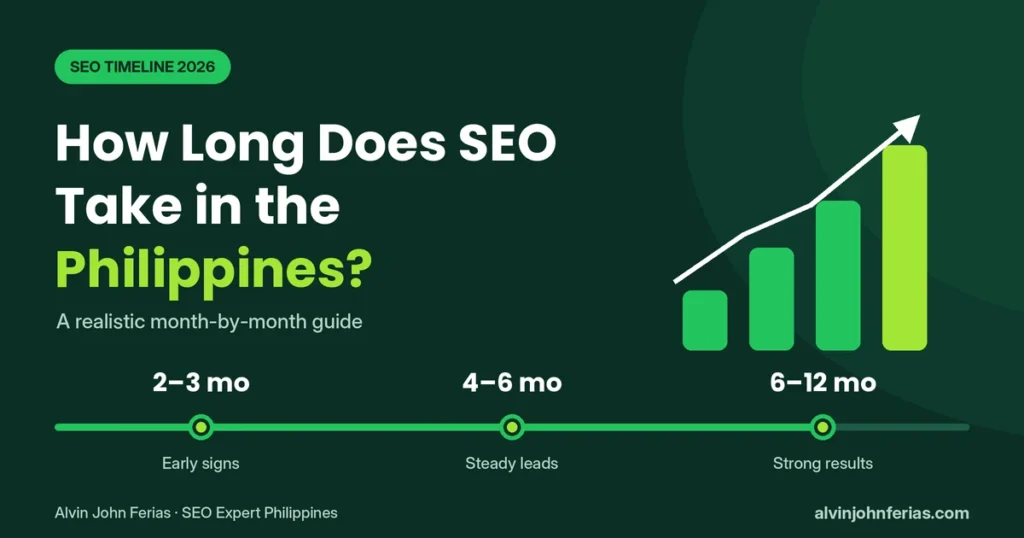
The honest answer: most websites see early movement in 2–3 months, meaningful leads in 4–6 months, and strong, compounding results in 6–12 months. But that range hides a lot. A plumbing company in Cavite with a clean site can win the map pack in eight weeks. A brand-new e-commerce store chasing national keywords might need a year or more.
I have built websites since 2008 and run SEO campaigns for clients in the Philippines, Australia, the US and the UK. In this guide I will walk you through a realistic month-by-month timeline, the factors that make SEO faster or slower, and the signs that tell you SEO is working long before you hit page one.
Quick answer: How long does SEO take in the Philippines? Expect 2–3 months for early signs (more impressions, long-tail rankings, map pack movement), 4–6 months for steady leads on low to medium competition keywords, and 6–12 months for competitive keywords. New domains and crowded national niches can take 12–18 months. Local SEO for a single location is usually the fastest win. Google itself says some changes take hours and others take months, and suggests waiting a few weeks before judging any single change.
SEO Timeline in the Philippines at a Glance
Your starting point decides your timeline more than anything else. Here is what I typically see across client sites, by scenario.
| Scenario | Example | First signs | Steady leads | Strong results |
|---|---|---|---|---|
| Quick fixes on an established site | Better titles, internal links, fixing indexing errors | 2–6 weeks | 1–3 months | 3–6 months |
| Local SEO, one location, low competition | Siphoning service in Cavite, resort in Oriental Mindoro | 3–8 weeks | 2–4 months | 4–6 months |
| Local SEO, competitive city | Dental clinic or law firm in Makati or BGC | 2–3 months | 4–8 months | 8–12 months |
| National SEO, established site | Supplier or B2B service serving the whole country | 2–4 months | 6–9 months | 9–12+ months |
| Brand-new domain | New business, new website | 3–6 months | 6–12 months | 12–18 months |
| E-commerce or very crowded niche | Online store, lending, real estate, BPO hiring | 3–6 months | 6–12 months | 12–24 months |
| Recovery from a penalty or bad migration | Lost rankings after spam links or a botched redesign | 1–3 months | 4–9 months | 9–12+ months |
These are working ranges, not guarantees. Anyone who promises page one in 30 days for a competitive keyword is either guessing or using tactics that can get your site penalized.
A Realistic Month-by-Month SEO Timeline
This is how a typical campaign unfolds for a Philippine small or medium business with an existing website. Your numbers will differ, but the order of events rarely does.
Month 1: Audit, fixes and foundations
The first month is mostly invisible to customers, and that is normal. This is when the groundwork happens.
- A full SEO audit of technical health, content, local presence and AI visibility
- Google Search Console, Analytics 4 and Google Business Profile set up and verified, under your ownership
- Critical technical fixes: indexing errors, broken redirects, slow pages, mobile problems
- Keyword and competitor research, so every page targets something people actually search
- Title tags, meta descriptions and headings rewritten on your most important pages
What you might see: pages that were not indexed start appearing, and Search Console impressions begin to rise.
Months 2–3: Early movement
Google has recrawled your fixed pages, and the first new content is live. Rankings begin to shift, usually for long-tail keywords first.
- New or improved service pages and location pages
- Google Business Profile optimized with categories, services, photos and weekly posts
- A review request process for happy customers
- Citations on Philippine directories with consistent name, address and phone
- Schema markup for your business, services and FAQs
What you might see: more impressions, rankings moving from page 5 to page 2, the first map pack appearances and a few organic inquiries.
Months 4–6: Traction and the first real leads
This is where most clients start to feel it. Content published in months 1–3 has matured, and your site has more trust signals.
- Steady content: blog posts that answer real customer questions
- Internal linking between related pages
- Local link building through partners, suppliers, associations and local news
- Conversion fixes, such as clearer calls, click-to-call buttons and Messenger links
What you might see: page 1 rankings for several medium-competition keywords, consistent calls or form submissions, and the first months where SEO pays back its fee.
Months 6–12: Compounding growth
SEO compounds. Each page you publish and each link you earn makes the next one rank faster.
- Topic clusters around your main services
- Digital PR and authority links for harder keywords
- Expansion to more cities, branches or service lines
- AI search optimization so ChatGPT, Gemini and Google AI Overviews mention your business
What you might see: top 3 rankings for core keywords, a steady share of leads from organic search, and lower cost per lead than paid ads.
Month 12 and beyond: Defend and expand
After a year, the job changes from climbing to staying on top. Competitors notice you, and Google keeps updating. Ongoing content, link building and technical upkeep protect what you have built while you go after the next set of keywords.
8 Factors That Decide How Fast SEO Works
Two businesses can hire the same SEO specialist on the same day and see results months apart. These eight factors explain why.
1. Keyword competition
“Siphoning Imus” and “best credit card Philippines” are different races. The more businesses already investing in a keyword, the more content and authority you need to pass them. Competition is usually the biggest single factor in your timeline.
2. Domain age and history
Google has no track record for a brand-new domain, so it tends to be cautious. An older domain with clean history and some existing backlinks usually moves faster. A domain with spam history can be slower than a new one.
3. Technical health
If Google cannot crawl, render or index your pages, nothing else matters. Slow hosting, noindex tags left on by mistake, broken redirects and poor mobile layouts can stall a campaign for months. Fixing technical SEO first is often the fastest way to speed everything up.
4. Content depth and quality
A 15-page site with thin service descriptions will rank slower than a site with detailed pages that answer real questions. Google rewards content that shows experience: local photos, real prices, actual project examples and clear answers.
5. Backlinks and brand mentions
Links from relevant, trusted Philippine and international sites act like votes of confidence. Earning them takes time, and buying cheap bulk links only adds risk. Most link building takes a few months to show its effect.
6. Local signals
For local businesses, your Google Business Profile, reviews, photos, and consistent name, address and phone across directories carry a lot of weight. A business with 80 recent reviews will usually win the map pack faster than one with 5.
7. How quickly changes get implemented
This one surprises people. Many campaigns lose two or three months waiting for a developer, an approval, or product photos. The faster recommendations go live, the faster results come.
8. Consistency and budget
SEO done in bursts rarely works. A steady campaign with a realistic budget beats an expensive one that stops after 60 days. My SEO pricing Philippines guide shows what each budget level can realistically deliver.
Local SEO vs National SEO vs AI Search: Different Clocks
Not every type of search visibility runs on the same timeline.
Local SEO: usually the fastest
For a single-location business, the Google map pack can move within weeks once your Google Business Profile is complete, your categories are right and reviews start coming in. Local service pages for each city you serve usually follow in 2–4 months.
In the Malabanan Siphoning case study, we built service and area pages into the revamp from day one, so the site launched ready to rank instead of waiting for a second project. If you serve Metro Manila, my guide to local SEO in Manila covers the map pack in more detail.
National SEO: slower, but bigger
Ranking across the whole Philippines means competing with established brands, media sites and marketplaces. Expect 6–12 months for meaningful results and more content and links than a local campaign.
AI search (AIO and GEO): a new timeline
Getting cited by ChatGPT, Gemini, Perplexity and Google AI Overviews depends on how well these systems understand your business as an entity. Structured data, consistent brand mentions, reviews and clear answer-style content all help.
Google AI Overviews tend to pull from pages that already rank well, so they usually follow your organic progress. Chat assistants can take longer, because they rely on mentions across many sources. In my own 105-answer AI visibility study, consistent entity signals built over years made the difference. My AI SEO Philippines guide explains the steps.
How to Speed Up SEO (Without Risking a Penalty)
You cannot force Google’s clock, but you can stop wasting time. These are the moves I use to get clients results sooner.
- Fix indexing and technical issues first. Submit an XML sitemap, check the Pages report in Search Console, and remove anything blocking Google. This is often the quickest win.
- Improve pages that already rank on page 2. Pages sitting in positions 8–20 are close. Better titles, fuller content and a few internal links can push them to page 1 in weeks.
- Target low-competition, high-intent keywords first. “Septic tank cleaning Dasmariñas” will bring calls long before “plumbing Philippines” does.
- Complete your Google Business Profile. Right primary category, all services listed, real photos, weekly posts and a steady flow of reviews.
- Build location and service pages properly. One focused page per service and per city you actually serve, each with unique details, not copy-pasted text.
- Earn local links. Suppliers, partners, chambers of commerce, sponsorships, local news and LGU or school events you are part of.
- Add schema markup. LocalBusiness, Service and FAQ schema help Google and AI assistants understand your business.
- Approve changes fast. Give your SEO specialist access and a quick sign-off process. Weeks of waiting add up.
- Run Google Ads in the meantime if you need leads now. Ads bring traffic while SEO matures, and the search term data shows which keywords convert.
What not to do: buying bulk backlinks, publishing dozens of unedited AI articles, or keyword stuffing. These shortcuts can trigger a manual action, and recovering from one takes far longer than doing it right.
How to Tell SEO Is Working Before You Hit Page One
Rankings are the last thing to move. Watch these earlier signals in Google Search Console, Analytics and your Business Profile.
| When | What to check | Healthy sign |
|---|---|---|
| Weeks 2–6 | Pages report in Search Console | More pages indexed, fewer errors |
| Months 1–3 | Impressions in Search Console | Impressions climbing month over month |
| Months 1–3 | Average position for target queries | Moving from page 4–5 toward page 2 |
| Months 2–4 | Google Business Profile insights | More profile views, calls and direction requests |
| Months 3–6 | Clicks and organic sessions | Clicks rising, not just impressions |
| Months 4–6 | Leads from organic search | Calls, forms and Messenger chats you can trace to Google |
| Months 6–12 | Revenue and cost per lead | Organic leads cheaper than paid ads |
If none of these move after 4–6 months, something is wrong. Usually it is a technical block, the wrong keywords or work that was never implemented. That is the time to ask for a second opinion, not to quit SEO altogether.
Frequently Asked Questions About SEO Timelines in the Philippines
How long does SEO take to work in the Philippines?
Most websites see early signs in 2–3 months, steady leads in 4–6 months and strong results in 6–12 months. Local SEO for a single location is often faster. New domains and competitive national keywords can take 12–18 months.
Can SEO work in one month?
Some quick fixes can show results within weeks, such as fixing indexing errors or improving titles on pages already ranking on page 2. A full campaign for competitive keywords will not deliver page 1 rankings in one month.
How long does local SEO take?
For a single-location business in a low-competition area, Google map pack improvements often show in 3–8 weeks. Competitive cities like Makati, BGC or Quezon City usually need 4–8 months.
How long does it take for a new website to rank on Google?
A new website usually needs 3–6 months to show early rankings and 6–12 months or more for meaningful traffic. Google has no history with a new domain, so trust builds gradually.
Why is my SEO taking so long?
The most common reasons are technical problems blocking indexing, targeting keywords that are too competitive, thin content, few reviews or links, and recommendations that were never implemented. An SEO audit will usually find the cause.
Should I stop SEO if I see no results after 3 months?
Not automatically. Check impressions, average position and indexed pages first. If those are improving, results are on the way. If nothing has moved at all, review the strategy and the work done before deciding.
Is Google Ads faster than SEO?
Yes. Ads can bring traffic the day they go live, but leads stop when the budget stops. SEO is slower to start but keeps working after the work slows down. Many businesses run both, then reduce ad spend as SEO grows.
How long before my business appears in ChatGPT or Google AI Overviews?
AI Overviews often follow your organic rankings, so they can appear within a few months for pages that rank well. Chat assistants like ChatGPT and Gemini usually take longer, because they rely on consistent brand mentions across many sources.
Final Thoughts
SEO is not slow because it does not work. It is slow because trust takes time, and Google is protecting its users from businesses that try to skip that step. The upside is that once you earn it, it keeps paying you back.
Set the right expectations: 2–3 months for early signs, 4–6 months for steady leads, and 6–12 months for results that compound. Start local, fix the technical basics first, measure the right signals, and give the work at least six months before you judge it.
Want to know how long SEO will take for your website specifically? Get a free SEO audit and I will show you where your site stands, what is holding it back, and a realistic timeline for your market. You can also explore my SEO services, local SEO services or call +63 992 835 6312.